How much does it cost to charge an e-bike battery in the UK?
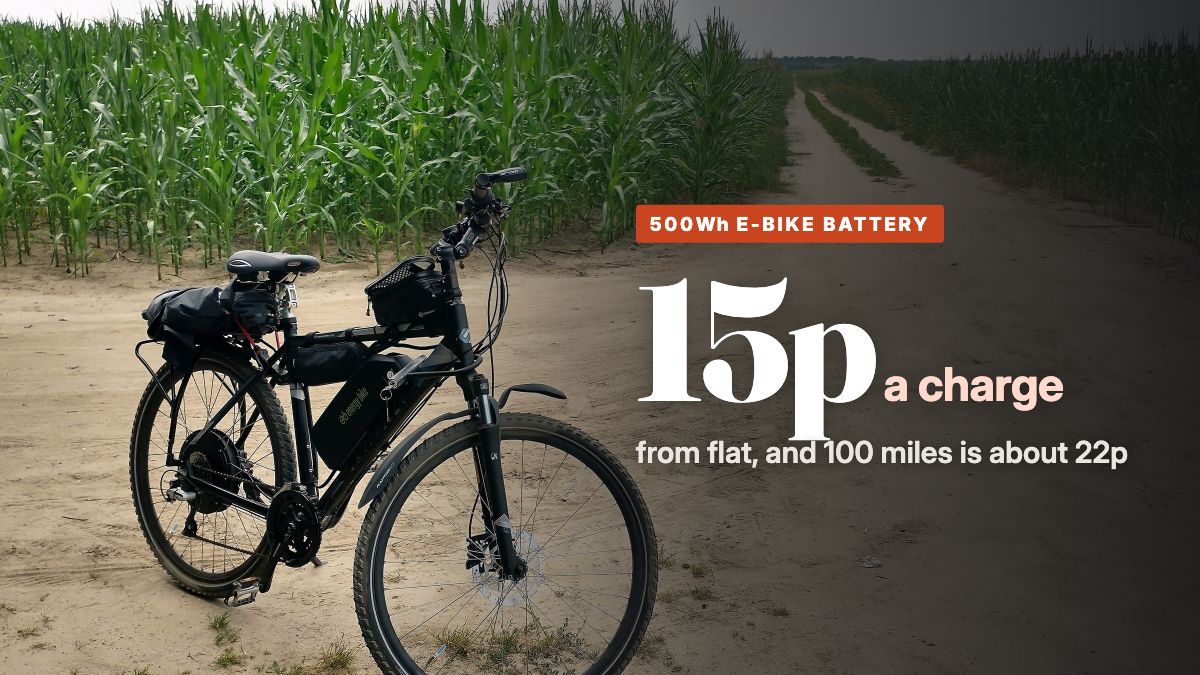
A 500Wh e-bike battery takes about 0.575 kilowatt hours from the wall once we allow 15 per cent for charger and battery losses, so a full charge from flat costs 15.1p at the Ofgem cap rate of 26.32p per kWh. Bosch quotes over 80 km, about 50 miles, of real range from its 360Wh PowerTube, which works out at roughly 22p per 100 miles. A 100 mile weekly commute therefore costs about 22p a week and £11.40 a year in electricity.
How much electricity an e-bike battery holds
An e-bike battery is rated in watt hours, which tells you the energy it stores. Bosch, which supplies the drive system on bikes from brands such as Trek, Scott and Riese & Müller, sells batteries from 360Wh up to 800Wh. Divide by 1,000 and you have kilowatt hours, the unit on your bill.
The wall supplies a little more than the battery stores, because the charger and the battery both lose some energy as heat. Bosch does not publish that loss on its battery pages, so we add 15 per cent as our own working figure. A 500Wh battery therefore takes about 0.575 kilowatt hours from the socket to go from flat to full.
Work it out for your own e-bike battery charge, 500Wh
Type in the wattage from the plate on the back, then your own unit rate. The numbers update as you type.
What a full charge costs
| Bosch battery | Stored | From the wall | Full charge from flat | Charge time quoted by Bosch |
|---|---|---|---|---|
| PowerTube 360 | 360 Wh | 0.41 kWh | 10.9p | not listed |
| 400Wh | 400 Wh | 0.46 kWh | 12.1p | about 3.5 hours |
| 500Wh | 500 Wh | 0.58 kWh | 15.1p | about 4.5 hours |
| 545Wh | 545 Wh | 0.63 kWh | 16.5p | about 4.9 hours |
| 625Wh | 625 Wh | 0.72 kWh | 18.9p | about 5.4 hours |
| 750Wh | 750 Wh | 0.86 kWh | 22.7p | about 6 hours |
| 800Wh | 800 Wh | 0.92 kWh | 24.2p | about 6.9 hours |
Most charges are not from flat. If you plug in at half full, you pay half of the figure in the fourth column, and a battery topped up after a short ride costs a penny or two.
Bosch also sells 2A, 4A, 6A and 12A chargers. A faster charger fills the battery sooner, but the energy going in is the same, so it changes the waiting time rather than the cost.
| Appliance | Typical draw | Usage we assume | Per hour (UK) | Per usage (UK) | Per month (UK) | Per hour (US) |
|---|---|---|---|---|---|---|
| E-bike battery charge, 500Wh | 0.57 kWh a cycle | per full charge from flat | 3.4p | 15.1p | £1.31 | 2.3 cents |
Rates: Ofgem cap 1 October to 31 December 2026 at 26.32p per kWh (source), EIA residential average June 2026 at 18.34 cents per kWh (source). Checked 2026-09-22.
Per mile, per week and per year
Range depends heavily on the assist mode, the hills and the weight on the bike, so treat any single figure as a guide. Bosch quotes over 80 km of real range from the 360Wh PowerTube, about 50 miles. With losses, that is roughly 8 watt hours a mile from the wall.
| Riding | Miles | Electricity | Cost |
|---|---|---|---|
| A five mile trip to the shops | 5 | 0.04 kWh | 1.1p |
| A day of 10 miles each way to work | 20 | 0.17 kWh | 4.4p |
| A working week of that commute | 100 | 0.83 kWh | 22p |
| A year of those weeks | 5,200 | 43.3 kWh | £11.40 |
| 100 miles in a Tesla Model 3 charged at home | 100 | 20.2 kWh | £5.32 |
A full year of commuting by e-bike costs about the same in electricity as two weeks of the same miles in an electric car charged at home. On the road the motor is limited by law to a continuous rated 250 watts and cuts out at 15.5 mph, and that limit is a large part of why the electricity costs so little.
Electric scooters
Electric scooters sit in the same bracket. Xiaomi's Electric Scooter 4 carries a 275.4Wh battery, takes about five hours to charge and is quoted at about 35 km of range, so a full charge costs 8.3p with losses and a mile costs well under half a penny.
The catch is legal rather than financial. London Fire Brigade's summary of the rules is that privately owned e-scooters cannot usually be used on public roads, pavements or cycle lanes in the UK and can only be ridden on private land with the landowner's permission. Rental e-scooters in trial areas are the exception, and their charging is the operator's cost.
Charging safely costs nothing extra
Fire services have been clear about lithium battery charging, and following their advice does not change the bill. London Fire Brigade advises using the charger supplied with the battery or one the manufacturer recommends, letting the battery cool after a ride before charging it, charging on a hard flat surface away from the main route out of the house, and unplugging once it is full. It also advises never leaving a battery charging unattended or while you are asleep.
That last point rules out the one cost saving people sometimes chase, which is charging overnight on a cheaper night rate. On a 500Wh battery a night rate 10p below the day rate would save less than 6p a charge, which is not worth the risk the fire brigade is warning about.
Where the real savings are
- Charge after the ride once the battery has cooled, while you are at home and awake, and unplug when it is full.
- Ride in a lower assist mode where you can. It stretches the range, so you charge less often.
- Keep the tyres pumped up to the pressure printed on the sidewall, because soft tyres take more effort from you and the motor.
- Do not pay extra for a faster charger to save money. It only saves time.
- If you are weighing an e-bike against the car for a commute, the electricity is close to a rounding error. The figures that matter are the purchase price and the car journeys it replaces.
What this costs in the United States
At the EIA residential average of 18.34 cents per kilowatt hour, a full charge of a 500Wh battery with losses costs 10.5 cents, and 100 miles of riding costs about 15 cents. A year of 100 mile weeks comes to $7.94. In California at 34.74 cents that year costs $15.05, and in Texas at 15.94 cents it costs $6.90.
Common questions
How much does it cost to charge an e-bike at home?
Between 11p and 24p for a full charge from flat, depending on the battery. That covers the 360Wh to 800Wh range Bosch sells, with 15 per cent added for losses in the charger and the battery. Topping up from half full costs half as much, so most charges after an ordinary ride cost a few pence.
How much electricity does an e-bike use?
Very little per mile. On Bosch's own range figure for its 360Wh battery, an e-bike uses roughly 8 watt hours a mile from the wall, so 100 miles needs about 0.83 kilowatt hours and costs 22p. Hills, headwinds, a heavy load and the highest assist mode all push that up, and gentle riding on a low mode brings it down.
Is it cheaper to charge an e-bike than an electric car?
By a factor of about 24. A Tesla Model 3 charged at home uses around 20.2 kilowatt hours per 100 miles, which costs £5.32 at the cap rate, against 22p for the same distance on an e-bike. The gap comes from weight, because an e-bike and rider weigh a small fraction of a car and the law limits the motor to 250 watts of continuous power.
How much does it cost to charge an electric scooter?
Xiaomi's Electric Scooter 4 has a 275.4Wh battery, so a full charge takes about 0.32 kilowatt hours with losses and costs 8.3p. Xiaomi quotes a range of about 35 km, which works out at roughly 0.38p a mile. Privately owned e-scooters can only be ridden on private land with the landowner's permission in the UK, so that running cost only applies where you are allowed to ride.
Can I charge my e-bike overnight to use cheaper electricity?
London Fire Brigade advises never leaving a battery charging unattended or while you are asleep, so overnight charging is the one saving to skip. It is also a small saving, because a cheaper night rate 10p below the day rate would take less than 6p off a full charge of a 500Wh battery.