How much does it cost to run an iron per hour in the UK?
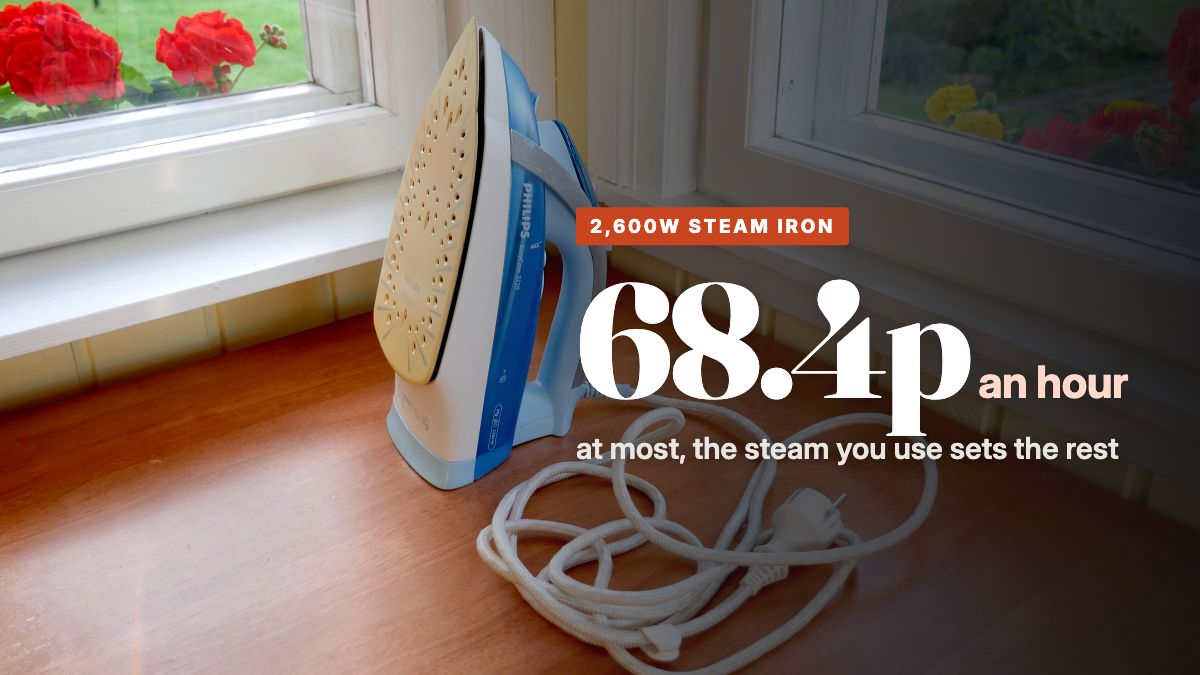
A 2,600 watt steam iron such as the Philips 3000 Series uses at most 2.6 kilowatt hours in an hour, which is 68.4p at the Ofgem cap rate of 26.32p per kWh. That figure is the ceiling, because the thermostat cuts the element once the soleplate is hot and only switches it back on to replace the heat you take out as steam. Every litre of water you turn into steam costs about 19.1p, so a light pile on a low steam setting costs well under the ceiling.
What an iron actually draws
An iron is a heating element bolted to a metal plate, with a thermostat deciding when the element is on. The number printed on the box is what it draws while the element is on, and for a modern iron that number is big.
Philips sells its 3000 Series steam iron, the DST3041, at 2,600 watts, and Tefal rates its Ultimate Pure FV9845 at 3,100 watts. Steam generators, the type with a separate base and a water tank, sit in a similar band. The Philips PerfectCare 7000 PSG7130 is rated at 2,100 watts, Tefal's Express Essential SV6116 at 2,200 watts, and the larger Philips PSG7200 at 3,120 watts.
None of them runs flat out for a full hour unless you make it. The element heats the soleplate to the temperature you set, the thermostat cuts it, and from then on it comes back on only to replace the heat that leaves the plate, mostly into the water you are turning into steam. The plate rating tells you the most an hour can possibly cost, and how you iron decides how far under that you land.
Work it out for your own steam iron
Type in the wattage from the plate on the back, then your own unit rate. The numbers update as you type.
The ceiling, worked for each iron
| Iron | Rating | At most per hour | An hour a week for a year |
|---|---|---|---|
| Philips PSG7130 steam generator | 2,100 W | 55.3p | £28.74 |
| Tefal Express Essential SV6116 steam generator | 2,200 W | 57.9p | £30.11 |
| Philips 3000 Series DST3041 steam iron | 2,600 W | 68.4p | £35.58 |
| Tefal Ultimate Pure FV9845 steam iron | 3,100 W | 81.6p | £42.43 |
| Philips PSG7200 steam generator | 3,120 W | 82.1p | £42.70 |
Those are the figures you would pay if the element never switched off, which is roughly what happens when you hold the steam button down for a whole session. A dry press of a few shirts with no steam at all comes in far below them.
| Appliance | Typical draw | Usage we assume | Per hour (UK) | Per usage (UK) | Per month (UK) | Per hour (US) |
|---|---|---|---|---|---|---|
| Steam iron | 2600 W | per hour at the full plate rating | 68.4p | 68.4p | £2.97 | 47.7 cents |
Rates: Ofgem cap 1 October to 31 December 2026 at 26.32p per kWh (source), EIA residential average June 2026 at 18.34 cents per kWh (source). Checked 2026-09-22.
Most of the electricity goes into the steam
This is the part that explains your bill, and it is simple physics rather than anything a manufacturer can tune. Taking a litre of water from a cold tap at about 15°C up to boiling, and then turning it into steam, takes about 2.6 megajoules of heat. That is 0.73 kilowatt hours, and at the cap rate of 26.32p it costs 19.1p.
So the water that goes out of the soleplate is a direct measure of what you spent. Philips quotes 40 grams a minute of continuous steam for the DST3041, and if you held that for a full hour you would turn 2.4 litres into vapour and need about 1.74 kilowatts just for the steam, which is most of the iron's rating. Nobody irons like that. In normal use you steam in bursts between dry passes, so the water that leaves the iron in an hour is a fraction of that, and turning the whole 1.5 litre tank of a PSG7200 into steam would take about 1.09 kilowatt hours.
| Water turned to steam | Electricity for the steam alone | Cost at 26.32p |
|---|---|---|
| 300 ml | 0.22 kWh | 5.7p |
| 600 ml | 0.44 kWh | 11.5p |
| 1 litre | 0.73 kWh | 19.1p |
| 1.5 litres, a full PSG7200 tank | 1.09 kWh | 28.7p |
On top of the steam there is a smaller amount of heat lost from the hot soleplate into the air and the board, which the thermostat keeps topping up. Put the two together and a normal hour usually falls somewhere between the steam figure for the water you used and the ceiling in the first table.
Steam iron or steam generator
A steam generator boils its water in a pressurised base and sends it down a hose, which is why it can deliver far more steam than an iron with a small tank in the handle. Tefal quotes 120 grams a minute for the SV6116 against 40 for the Philips DST3041. More steam per minute means more electricity per minute, but it also means the creases come out in fewer passes, so a pile of school shirts takes less time.
The warm up is worth knowing about if you iron in short bursts. Tefal puts the SV6116 at two minutes to heat, which at 2,200 watts is about 0.07 kilowatt hours and 1.9p every time you switch it on. The Philips DST3041 is ready in 35 seconds, which at 2,600 watts is 0.7p. Neither is much on its own, but heating a generator three times a week for one shirt each time costs more than heating it once for all three.
The eco settings on generators are worth using. Philips states up to 30 per cent energy saving in the normal mode of the PSG7130 against its maximum, measured to the IEC 60311 test, and up to 50 per cent less energy in the eco mode of the PSG7200. Both deliver less steam in those modes, which is exactly where the saving comes from.
Against the other laundry jobs
An hour of ironing at the full 2,600 watt ceiling uses about the same electricity as one load in a vented or condenser tumble dryer, which runs at around 2.5 kilowatt hours a load and is covered in our tumble dryer guide. It uses nearly four times what a 40 degree wash costs in the washing machine.
The real hour of ironing sits below that, so for most households the iron is a smaller line on the bill than the dryer. The exception is the household that irons everything, sheets and towels included, with the steam on full for two or three hours on a Sunday. That can add up to the cost of a dryer load each week without anyone noticing.
Ways to cut what ironing costs
- Use the eco or lower steam setting for cottons that are only lightly creased, because the saving comes straight out of the water you are not boiling.
- Iron everything in one session rather than heating the iron or the generator several times a week.
- Iron the delicate items first while the plate is still coming up to temperature, then move to cottons and linen at the hotter setting.
- Take shirts out of the washing machine as soon as it finishes and hang them on hangers to dry, since fewer deep creases means less steam later.
- Switch off at the plug for the last minute or two, because the soleplate holds enough heat for a final handkerchief or pillowcase.
- Let the auto off do its job. Tefal's FV9845 switches itself off after 30 seconds left on its side or soleplate and after 8 minutes on its heel, so a forgotten iron costs pennies at most.
What this costs in the United States
At the EIA residential average of 18.34 cents per kilowatt hour, the 2,600 watt ceiling is 47.7 cents an hour and a litre of water turned to steam costs 13.3 cents. In California, at 34.74 cents, the same hour can reach 90.3 cents, and in Texas at 15.94 cents it tops out at 41.4 cents.
Common questions
How much does it cost to run an iron for one hour?
No more than the plate rating allows. A 2,600 watt steam iron costs at most 68.4p for an hour at the cap rate of 26.32p per kWh, a 2,200 watt steam generator 57.9p and a 3,100 watt model 81.6p. The thermostat keeps the element off for part of the hour, so the real figure is lower unless you are steaming almost constantly.
How much electricity does an iron use?
Its rating in kilowatts for every hour the element is on, so 2.6 kilowatt hours an hour for a 2,600 watt iron at the most. In practice the amount follows the steam, because turning one litre of tap water into steam takes about 0.73 kilowatt hours, which is 19.1p at the current cap.
Does an iron use a lot of electricity?
Per minute, yes, it is one of the most powerful things you plug in, on a par with a kettle. Across a week it is modest, because most people iron for an hour or less. An hour a week at the full 2,600 watt ceiling comes to £35.58 over a year, and the real figure is usually lower.
Does a steam generator cost more to run than a steam iron?
Per minute it can, because it pushes out three times as much steam and every gram of steam is paid for in electricity. Per pile it is often level or cheaper, because the extra steam gets through the pile faster. The Philips PerfectCare models carry an eco mode that Philips puts at up to 30 per cent or 50 per cent less energy depending on the model.