How much does a washer dryer cost per load in the UK?
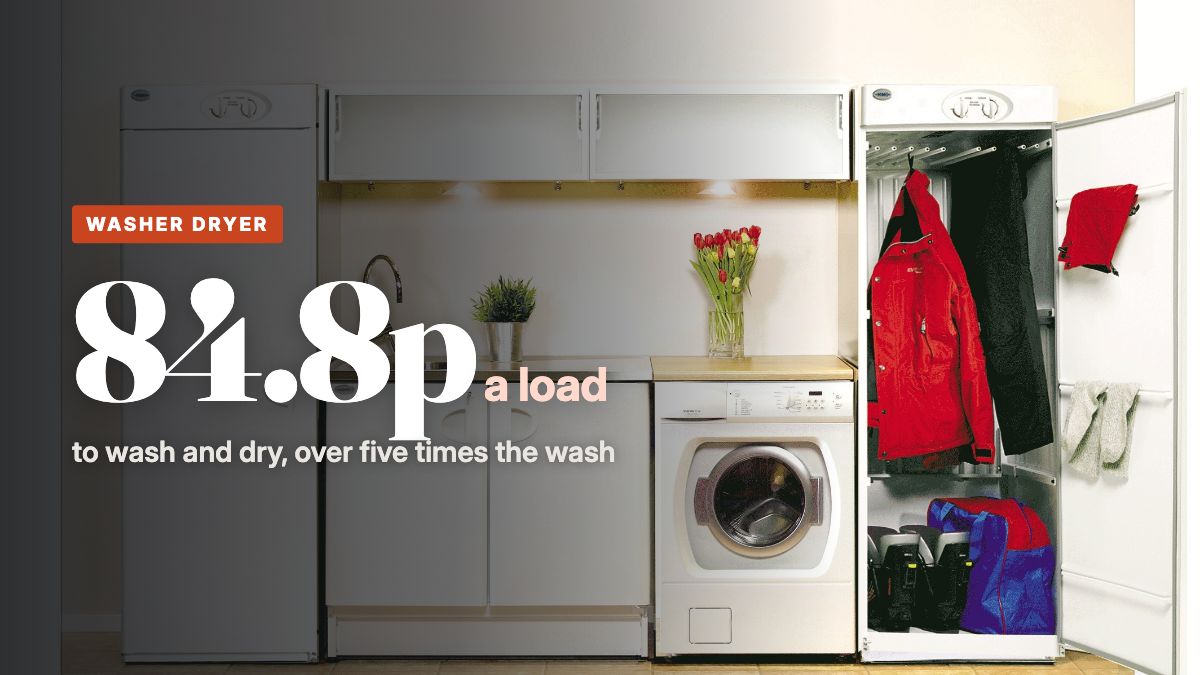
A 9 kg Bosch Series 4 washer dryer is rated at 3.22 kilowatt hours for a wash and dry cycle, which costs 84.8p at the Ofgem cap rate of 26.32p per kWh. The eco 40-60 wash on its own uses 0.567 kilowatt hours and costs 14.9p, so nearly all of the cost is the drying. Three wash and dry loads a week add up to about £132.21 a year.
What a washer dryer uses per load
A washer dryer costs about 84.8p to wash and then dry a load at the current cap, and the figure comes straight off the energy label. Bosch's Series 4 WNA144V9GB, a 9 kg wash and 5 kg dry machine, is rated at 3.220 kilowatt hours for a wash and dry cycle and 0.567 kilowatt hours for its eco 40-60 wash on its own. Both figures are averages across full and part loads, which is how the UK energy label measures them.
That makes the drying just over four fifths of the electricity. The gap between the two label figures is about 2.65 kilowatt hours, which is roughly what the drying adds, and it is the reason a washer dryer that is cheap to run as a washing machine can be an expensive one to run as a dryer.
Work it out for your own washer dryer, wash and dry
Type in the wattage from the plate on the back, then your own unit rate. The numbers update as you type.
Four Bosch machines, label against label
| Model | Wash / dry capacity | Wash only | Wash and dry | Wash and dry class | Cost to wash and dry |
|---|---|---|---|---|---|
| Bosch Series 4 WNA144V9GB | 9 kg / 5 kg | 0.567 kWh | 3.220 kWh | E | 84.8p |
| Bosch WNG25401GB | 10.5 kg / 6 kg | 0.514 kWh | 3.060 kWh | D | 80.5p |
| Bosch WNC254ARGB | 10.5 kg / 6 kg | 0.522 kWh | 3.050 kWh | D | 80.3p |
| Bosch WKD28490GB integrated | 8 kg / 5 kg | 0.472 kWh | 3.240 kWh | E | 85.3p |
The spread between the best and worst of the four is under 0.2 kilowatt hours a load, about 5.0p. The washing efficiency classes are mostly A, and the wash and dry classes are D or E, which shows where the energy goes in any machine that does both jobs.
| Appliance | Typical draw | Usage we assume | Per hour (UK) | Per usage (UK) | Per month (UK) | Per hour (US) |
|---|---|---|---|---|---|---|
| Washer dryer, wash and dry | 3.22 kWh a cycle | per wash and dry cycle (energy label) | 11.3p | 84.8p | £11.02 | 7.9 cents |
Rates: Ofgem cap 1 October to 31 December 2026 at 26.32p per kWh (source), EIA residential average June 2026 at 18.34 cents per kWh (source). Checked 2026-09-22.
A week and a year
| Loads a week | Wash only, per year | Wash and dry every load, per year | Wash every load and dry half, per year |
|---|---|---|---|
| 2 | £15.52 | £88.14 | £51.83 |
| 3 | £23.28 | £132.21 | £77.75 |
| 5 | £38.80 | £220.35 | £129.58 |
Drying only the loads that cannot go on a line or an airer is the single biggest saving. Washing three loads a week but drying only half of them, with the rest hung up, brings the year down from £132.21 to £77.75.
The drying capacity catch
The drying capacity on a washer dryer is smaller than the washing capacity. The WNA144V9GB washes 9 kg but dries 5 kg, and the 10.5 kg machines dry 6 kg. If you fill the drum for the wash, some of it has to come out before the drying starts, or it has to be dried in two runs, and the second run can add most of another 2.65 kilowatt hours. Households that wash big loads and dry everything can end up paying well over the 84.8p per load that the label suggests.
The wash and dry cycle is also long. Bosch gives the WNA144V9GB 7 hours 30 minutes for a full wash and dry and 5 hours 10 minutes for a half load, and the integrated WKD28490GB 9 hours 20 minutes for a full one. Spread over seven and a half hours, the 3.22 kilowatt hours work out at about 0.43 kilowatt hours each hour, or 11.3p an hour on average.
Water use rises too. The same Bosch label puts the wash and dry cycle at 74 litres against 46 for the wash alone, because most washer dryers use water to condense the moisture they pull out of the clothes.
Against a washing machine and a separate dryer
A separate washing machine and condenser or vented dryer use about the same electricity as a washer dryer. A 40 degree washing machine wash runs at around 0.68 kilowatt hours, and a vented or condenser tumble dryer at about 2.5 kilowatt hours a load, which comes to 3.18 against the washer dryer's 3.22.
A heat pump tumble dryer changes that. At about 1.5 kilowatt hours a load, the washing machine and heat pump pair comes to roughly 2.2 kilowatt hours, a kilowatt hour less than the washer dryer. At three loads a week that is about £41.06 a year. A washer dryer earns its place in a small kitchen with room for one machine, while two machines with a heat pump dryer cost less to run where there is space.
Ways to cut what a washer dryer costs
The cheapest load is the one that is washed in the machine and dried somewhere else, so most of the saving comes from drying less often.
- Dry on a line, an airer or a heated airer whenever you can, because the drying is over four fifths of the cost.
- Use the highest spin the fabric allows before drying, since water spun out in the wash does not have to be evaporated in the dryer.
- Keep the drying load at or below the drying capacity rather than the washing capacity, so one drying run does the job.
- Use the eco 40-60 programme for everyday washes, which is the programme behind the 0.567 kilowatt hour label figure.
- On a time of use tariff, use the delay start to run the load in the cheap hours, since the wait costs about 0.84p for eight hours at 4 watts.
What this costs in the United States
At the EIA residential average of 18.34 cents per kilowatt hour, a 3.22 kilowatt hour wash and dry costs 59.1 cents and three loads a week about $92 a year. In California, at 34.74 cents, a load is $1.12, and in Texas at 15.94 cents it is 51.3 cents.
Common questions
How much does it cost to run a washer dryer per load?
About 84.8p for a full wash and dry at the cap rate of 26.32p per kWh, based on the 3.22 kilowatt hours on the energy label of a 9 kg Bosch Series 4. Washing without drying costs about 14.9p on the eco 40-60 programme, and the other Bosch models we checked sit between 3.05 and 3.24 kilowatt hours for a wash and dry.
Does a washer and dryer use a lot of electricity?
The drying does. A wash on its own uses around half a kilowatt hour, while a wash and dry uses about 3.2, so drying accounts for just over four fifths of the electricity. At three loads a week a washer dryer uses about 500 kilowatt hours a year, which is £132.21 at the current cap.
Is it cheaper to run a washer and dryer at night?
Only if your tariff charges less at night. On a standard tariff at the price cap the unit rate is the same at any hour, so a load costs 84.8p whenever it runs. On a time of use tariff, the delay start on the Bosch models draws 4 watts while it waits, which is 0.84p for eight hours, so shifting the load costs almost nothing.
Is a washer dryer cheaper to run than a separate tumble dryer?
About the same as a washing machine and a condenser or vented dryer, which together use around 3.2 kilowatt hours a load. A washing machine with a heat pump dryer uses about 2.2, which saves roughly £41.06 a year at three loads a week.