How much does a bread maker cost to run per loaf in the UK?
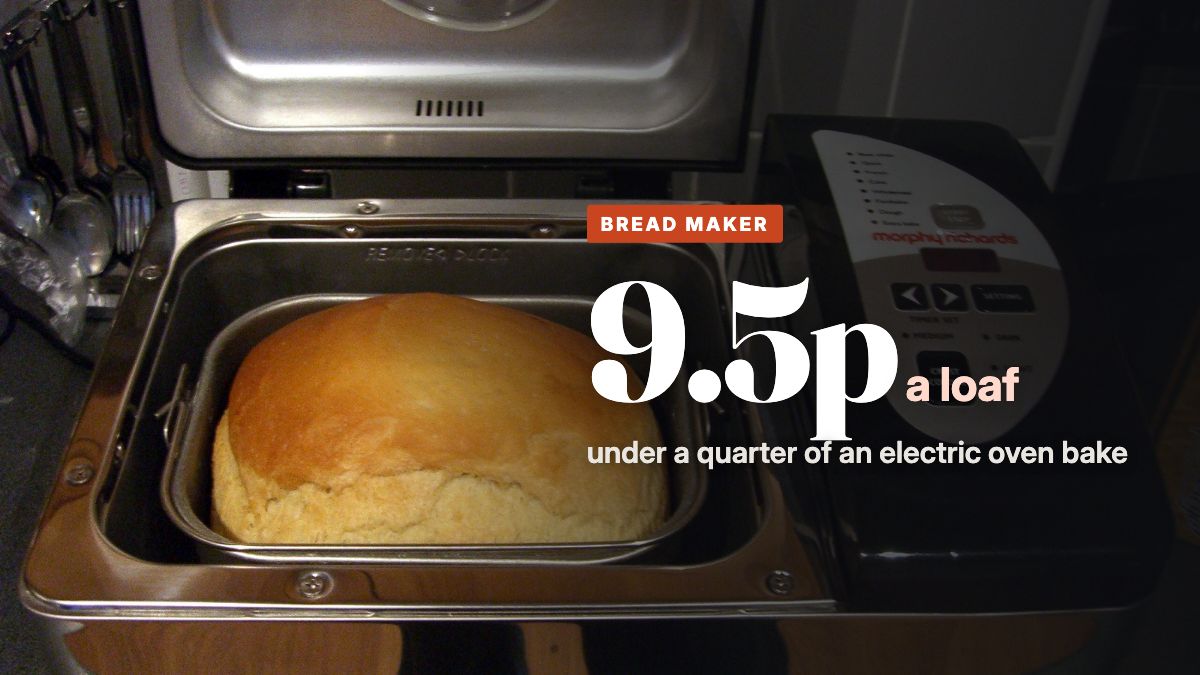
A typical bread maker uses about 0.36 kilowatt hours to make one white loaf on the basic programme, which costs 9.5p at the Ofgem cap rate of 26.32p per kWh. Which? measured machines between 0.20 and 0.49 kilowatt hours a loaf, so the real range is 5.3p to 12.9p, and two loaves a week costs about £9.85 a year.
What a bread maker actually uses
The plate on a bread maker gives a figure that sounds expensive and is not what you pay for. Panasonic's operating instructions list the SD-YR2550, SD-YR2540, SD-R2530 and SD-B2510 at 550 watts, and that is the heating element at full power. A loaf does not need full power for long. Most of a cycle is kneading and rising, where the motor turns the paddle and the element only warms the tin enough to keep the yeast working, and the element runs hard only during the final bake.
What matters is the energy for the whole loaf, and that has been measured. Which? put an energy monitor on its test machines and found an average of 0.36 kilowatt hours for a white or wholemeal loaf, with an average cycle of 3 hours 18 minutes for white bread and 3 hours 54 minutes for wholemeal. Its more recent testing of 1 kg white loaves works out at between 0.20 and 0.49 kilowatt hours a loaf depending on the machine, and Which? noted that the differences between models were fairly small.
Spread across a cycle of about three and a quarter hours, 0.36 kilowatt hours is an average draw of roughly 110 watts, which is less than many televisions.
Work it out for your own bread maker
Type in the wattage from the plate on the back, then your own unit rate. The numbers update as you type.
The calculator starts at that average, 109 watts for 3.3 hours. If you would rather type in the 550 watts from your own machine's plate, set the hours to about 0.65, which is roughly how long the element would need at full power to use the same energy as a whole loaf. Entering 550 watts for the full three hours overstates the cost about five times.
The cost per loaf, per month and per year
At the Ofgem cap rate of 26.32p per kilowatt hour a typical loaf costs 9.5p. Baking two loaves a week uses 37.4 kilowatt hours a year and costs £9.85, or about 82p a month.
| How the loaf is baked | Energy per loaf | Per loaf | Two a week, per month | Two a week, per year |
|---|---|---|---|---|
| Most efficient bread maker Which? measured | 0.20 kWh | 5.3p | £0.46 | £5.47 |
| Typical bread maker, basic white | 0.36 kWh | 9.5p | £0.82 | £9.85 |
| Least efficient bread maker Which? measured | 0.49 kWh | 12.9p | £1.12 | £13.41 |
| Gas oven, one loaf | 1.5 kWh of gas | 12.0p | £1.04 | £12.43 |
| Electric oven, one loaf | 1.6 kWh | 42.1p | £3.65 | £43.80 |
The oven figures come from the Energy Saving Trust and are quoted by the Real Bread Campaign. They are for one loaf on its own, so the whole preheat is charged to that single tin.
| Appliance | Typical draw | Usage we assume | Per hour (UK) | Per usage (UK) | Per month (UK) | Per hour (US) |
|---|---|---|---|---|---|---|
| Bread maker | 0.36 kWh a cycle | per loaf on the basic white programme | 2.9p | 9.5p | 82.1p | 2.0 cents |
Rates: Ofgem cap 1 October to 31 December 2026 at 26.32p per kWh (source), EIA residential average June 2026 at 18.34 cents per kWh (source). Checked 2026-09-22.
Bread maker against the oven
An electric oven has to heat a large insulated box and hold it at temperature before the bread starts to bake, and a single loaf barely uses the space it has paid to heat. A bread maker heats a small tin wrapped closely around the dough. That is the whole reason it costs about a quarter as much per loaf, at 9.5p against 42p.
A gas oven narrows the gap a long way. Gas costs 7.97p a kilowatt hour on the current cap against 26.32p for electricity, so the 1.5 kilowatt hours a gas oven needs for a loaf comes to about 12p. The bread maker still edges it, and it does so without anyone standing in the kitchen watching the timer.
The oven claws back ground when it is full. Two tins side by side share the same preheat, so each loaf carries half of it, and a tray of rolls baked alongside the Sunday roast costs almost nothing extra because the oven was hot anyway. If you only ever bake one loaf at a time, the bread maker is the cheaper machine. If you bake in batches, the oven is less wasteful than the single loaf figure suggests. Our guide to running an electric oven has the cost of an oven hour on its own.
Using the timer and a cheaper tariff
Bread makers were designed to run overnight, so you can set one to finish for breakfast without worrying about it. Panasonic's machines take a delay of up to 13 hours, counted as the time until the bread is ready, and the instructions specifically say not to use an external timer. Plugging the machine into a socket timer so it starts later is the one way of doing this that the manufacturer tells you not to use.
The built in delay is also how you take advantage of a time of use tariff. If your supplier charges less for electricity overnight, setting the loaf to finish at six in the morning puts the whole bake inside the cheap window, and the loaf gets cheaper in exact proportion to the discount. An overnight rate at half the cap price halves the 9.5p.
Making each loaf cheaper
- Keep the lid closed while it bakes. Lifting it during the final stage lets out heat the element has already paid for and can lengthen the bake.
- Use the dough programme for pizza bases and rolls when the oven is already on for something else, so the bread maker does the kneading and rising and the bake rides on heat you were using anyway.
- Slice and freeze what you will not eat in two days. A loaf that goes stale and ends up in the bin wastes every penny of flour, yeast and electricity, and the electricity is the smallest of the three.
- Set the delay timer to finish inside an off peak window if you are on a time of use tariff.
Is a bread maker worth it on running cost
On electricity alone a bread maker is one of the cheapest ways to bake that you can buy. At 9.5p a loaf it uses about the same electricity as boiling a full kettle twice, and less than a quarter of what the same loaf takes in an electric oven. The decision about whether home made bread saves money comes down to the price of flour, yeast and the machine itself, because the electricity is a few pence a loaf whichever way you look at it.
Common questions
Are bread makers expensive to run?
No. A standard white loaf uses about 0.36 kilowatt hours, which is 9.5p at the current cap rate, and two loaves a week adds up to £9.85 over a year. The flour and yeast in the tin cost more than the electricity that bakes them.
Is it cheaper to use a bread maker or an oven?
The bread maker, by a wide margin if your oven is electric. The Energy Saving Trust put an electric oven loaf at about 1.6 kilowatt hours, which is 42p against 9.5p in a bread maker. A gas oven is much closer, at about 1.5 kilowatt hours of gas and 12p a loaf, because gas costs a fraction of electricity per unit.
How much electricity does a bread maker use?
The heating element is rated at around 550 watts in the Panasonic range, but it only runs at that level for part of the bake. Across a whole cycle of about three and a quarter hours a white loaf uses about 0.36 kilowatt hours, an average of roughly 110 watts, and Which? measured machines between 0.20 and 0.49 kilowatt hours a loaf.
Can you leave a bread maker on overnight?
Yes, that is what the delay timer is for. Panasonic's machines let you set the time the loaf should be ready up to 13 hours ahead, and the manual specifically says not to run the machine from an external plug in timer. The built in timer is also the way to bake inside the cheap hours of a time of use tariff.