How much does a coffee machine cost to run per day in the UK?
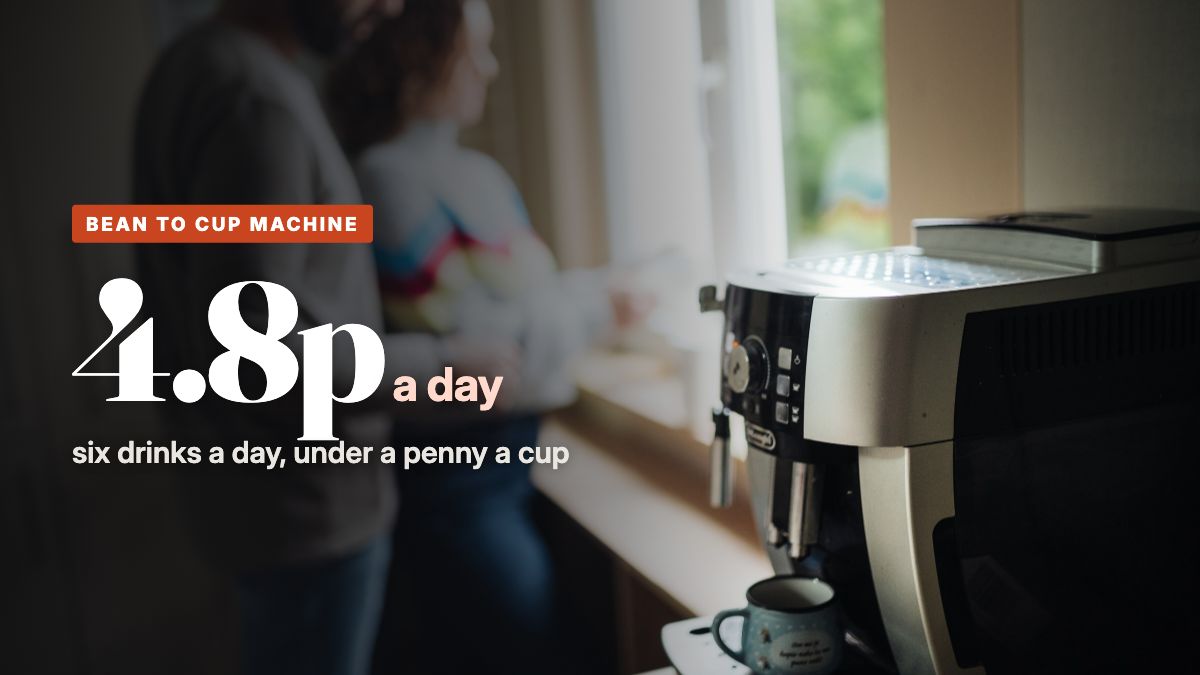
A bean to cup coffee machine costs about 4.8p a day to run, based on a class B machine rated at 66 kilowatt hours a year for six drinks a day in two sessions under the Swiss energy label test, and the Ofgem cap rate of 26.32p per kWh. That is £17.37 a year, or 0.79p a cup. An efficient model uses 43 kilowatt hours a year, 3.1p a day, and a machine without auto power down can reach 196 kilowatt hours, 14.1p a day.
What a coffee machine actually uses
A coffee machine draws a lot of power for a few minutes and almost nothing the rest of the day, which is why the label on the back is no guide to the bill. De'Longhi lists its Magnifica S bean to cup machine at 1,450 watts, and Krups lists the Nespresso Essenza Mini pod machine at 1,200 to 1,310 watts. Those figures are the heater at full power while it warms up and brews.
The real number comes from measuring a whole day of use. The Swiss energy label, which Topten uses to rank machines, tests coffee makers over 730 coffee sessions a year, two a day, with three drinks in each, so six drinks a day in all. On that test Topten's procurement guide quotes 66 kilowatt hours a year for a fully automatic machine in energy class B and 43 for one in class A. At the Ofgem cap rate of 26.32p per kilowatt hour, the class B machine costs 4.8p a day and the class A machine 3.1p.
Work it out for your own bean to cup coffee machine
Type in the wattage from the plate on the back, then your own unit rate. The numbers update as you type.
The calculator spreads that daily figure over 24 hours as a steady 8 watts, which rounds it up slightly to 5.1p a day. If you make more than six drinks a day, scale the result up roughly in proportion, since each extra drink adds a little heating on top of the warm up.
What a day, a month and a year cost
| Machine and how it behaves | kWh a year | Per day | Per month | Per year |
|---|---|---|---|---|
| Efficient capsule machine, Topten's best | 23 | 1.7p | £0.50 | £6.05 |
| Capsule machine, class A++ | 34 | 2.5p | £0.75 | £8.95 |
| Bean to cup, class A | 43 | 3.1p | £0.94 | £11.32 |
| Filter machine, 30 minutes on the hot plate | 54 | 3.9p | £1.18 | £14.21 |
| Capsule machine, class A | 58 | 4.2p | £1.27 | £15.27 |
| Bean to cup, class B | 66 | 4.8p | £1.45 | £17.37 |
| Capsule machine kept hot | 140 | 10.1p | £3.07 | £36.85 |
| Bean to cup without auto power down | 196 | 14.1p | £4.30 | £51.59 |
All of these are on the same six drinks a day. The capsule figures at 23 and 140 kilowatt hours and the bean to cup figure at 196 come from the criteria paper Topten published with the Oeko-Institut, and the filter figure assumes 2,190 cups a year with the hot plate on for half an hour after each brew.
| Appliance | Typical draw | Usage we assume | Per hour (UK) | Per usage (UK) | Per month (UK) | Per hour (US) |
|---|---|---|---|---|---|---|
| Bean to cup coffee machine | 0.18 kWh a cycle | per day, six drinks in two sessions | 0.20p | 4.8p | £1.45 | 0.14 cents |
Rates: Ofgem cap 1 October to 31 December 2026 at 26.32p per kWh (source), EIA residential average June 2026 at 18.34 cents per kWh (source). Checked 2026-09-22.
Why the same machine can cost three times as much
The gap between 66 and 196 kilowatt hours a year is almost all keeping hot. A bean to cup or capsule machine holds a boiler or thermoblock at brewing temperature so it is ready the moment you press the button, and that ready mode runs whether or not anyone is drinking coffee. Topten's criteria paper says keeping warm can account for up to 75 per cent of a machine's yearly energy, depending on how the owner switches it off.
That is why auto power down matters more than anything printed on the box. Topten only recommends automatic machines that drop out of ready mode within 30 minutes by default, and capsule machines within 15 minutes, with no setting that turns the function off. The Essenza Mini goes further and switches off after 9 minutes unless you change it to 30. If your machine has a menu setting for the auto off time, the shortest time that suits your mornings is the cheapest one.
Bean to cup against pods
On electricity alone the two are close. Topten's figures put an efficient capsule machine at 34 kilowatt hours a year and a less efficient one at 58, against 43 and 66 for bean to cup, so a pod machine is usually a few pounds a year cheaper to power.
The electricity is the small part of the cost per cup. At 0.79p a drink for a class B bean to cup machine, the power is a fraction of what the coffee costs, and Topten's criteria paper found that coffee from capsules cost more than three times as much per cup as beans ground in an automatic machine. Anyone choosing between the two on running cost should be comparing the price of beans against the price of pods.
Coffee machine against the kettle
A kettle is not automatically the cheap option. A mug of 250 millilitres needs about 0.025 kilowatt hours to boil, so six carefully measured mugs cost 3.9p a day. Most kettles will not boil less than half a litre, though, and six minimum boils a day cost 7.7p, more than an efficient bean to cup machine making the same six drinks. If you make one cup at a time, a well behaved coffee machine is no extravagance.
Keeping the running cost down
- Leave auto power down switched on, and set it to the shortest delay the menu offers.
- Make drinks back to back when you can. The test that produces these figures assumes two sessions a day, and a machine woken from cold ten times a day spends more energy on warm ups.
- Descale on schedule, because scale on the heater makes it work harder for every drink.
- Turn a filter machine's hot plate off and pour the coffee into a vacuum jug instead of leaving it to stew.
- Switch the machine off at the wall if you are away for more than a day or two, although at 0.5 watts or less the standby saving is tiny.
Is a coffee machine worth it on running cost
A bean to cup machine costs about 4.8p a day and £17.37 a year to run on six drinks a day, which is under a penny a cup. The one setting that changes that by pounds a year is auto power down, and on electricity alone a modern machine with it switched on costs about the same as making the same drinks with the kettle. The beans or pods in it will always cost far more than the power.
Common questions
Do coffee machines use a lot of electricity?
Not if they switch themselves off. A bean to cup machine making six drinks a day uses about 66 kilowatt hours a year, which is £17.37 at the current cap and less than a penny a cup. The heater draws over a kilowatt while it works, but only for the minutes it spends heating up and brewing.
Can you leave a coffee machine on all day?
You can leave it plugged in, because modern machines drop into standby on their own and the EU standby rules cap that at 0.5 watts, or 1 watt with a display. What costs money is a machine kept hot all day. Topten found that an automatic machine without auto power down can use 196 kilowatt hours a year, about £34 more than one that switches off.
Do Nespresso machines use a lot of electricity?
Very little in a day. Krups lists the Nespresso Essenza Mini at 1,200 to 1,310 watts, but it switches off after 9 minutes by default and draws 0.1 watts when off. Topten puts efficient capsule machines at 34 kilowatt hours a year, which is £8.95, or 2.5p a day.
Is it cheaper to make coffee with a kettle or a coffee machine?
There are only a few pence in it either way. Boiling exactly 250 millilitres for each of six mugs costs 3.9p a day, but most kettles will not boil less than half a litre, which takes it to 7.7p. A class B bean to cup machine costs 4.8p a day and an efficient pod machine 2.5p.