How much does it cost to run an Xbox Series X per hour in the UK?
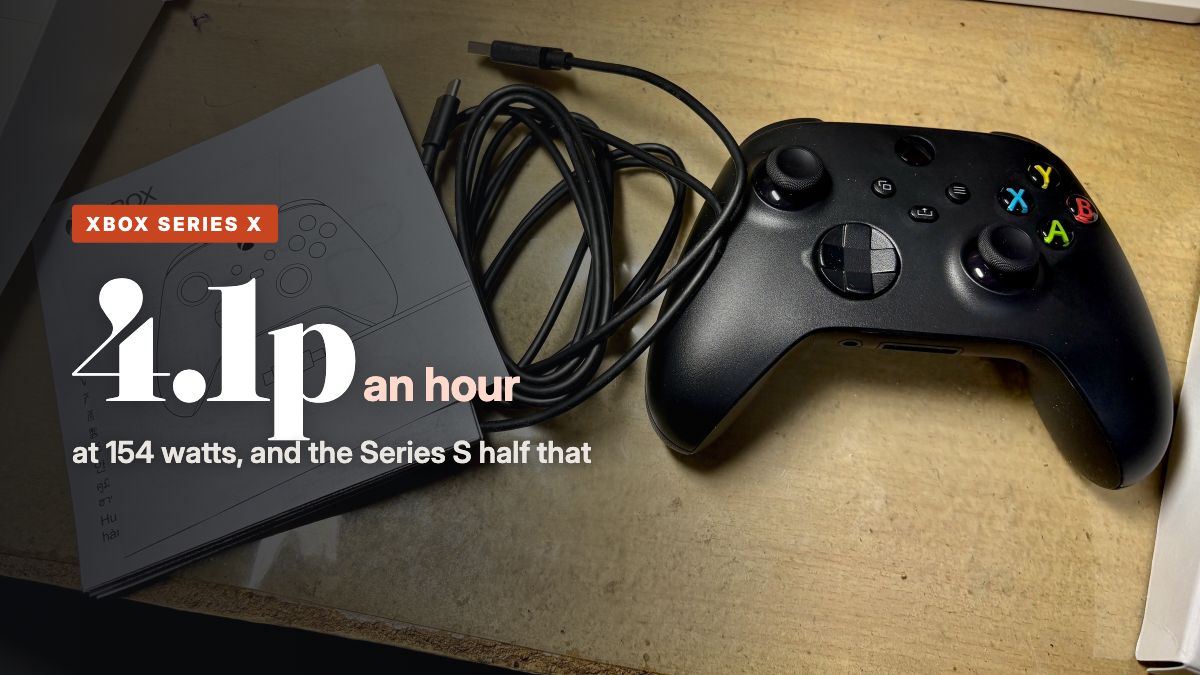
Microsoft measures the Xbox Series X at 154 watts at the wall across more than 200 games, which costs 4.1p an hour at the Ofgem cap rate of 26.32p per kWh and 12.2p for a three hour session. The Series S draws 74 watts, 1.9p an hour. Between sessions, Sleep mode draws 10 to 15 watts against 0.5 watts for Shutdown, which over a year is £21 to £31 against about £1.
What an Xbox Series X draws
Microsoft runs its own sustainability lab for Xbox and publishes the results. Measured at the wall across more than 200 games, the Series X averages 154 watts during active gameplay, and the Series S averages 74 watts. Those are averages, so a demanding new release will sit above the figure and an older or simpler game below it. Eurogamer's metering of a Series X running a demanding game, reported by TheGamer, came to about 165 watts, which is the top of the range we use.
The lab also measured every other state a console spends time in, and the figures show the console barely slows down when you stop playing. Cutscenes and multiplayer matches both average 150 watts, the pause menu 140 watts, a game's main menu 123 watts and loading screens 105 watts. A game left paused at the menu while you make dinner is costing you nine tenths of what playing it would.
The figure most people never see is the one for the hours the console is off. Microsoft's Xbox Wire puts Sleep mode at 10 to 15 watts and the Shutdown (energy saving) mode at 0.5 watts, which it describes as up to 20 times less power while the console is off.
Work it out for your own Xbox Series X
Type in the wattage from the plate on the back, then your own unit rate. The numbers update as you type.
Per hour in every state
| What the Series X is doing | Draw | Per hour | Three hours |
|---|---|---|---|
| Demanding game, Eurogamer's metering | 165 W | 4.34p | 13.0p |
| Average game, Microsoft lab | 154 W | 4.05p | 12.2p |
| Cutscene or multiplayer match | 150 W | 3.95p | 11.8p |
| Paused in a game | 140 W | 3.68p | 11.1p |
| Sitting on a game's main menu | 123 W | 3.24p | 9.7p |
| Loading screen | 105 W | 2.76p | 8.3p |
| Series S, average game | 74 W | 1.95p | 5.8p |
| Sleep mode, top of Microsoft's range | 15 W | 0.39p | 1.18p |
| Shutdown (energy saving) | 0.5 W | 0.013p | 0.039p |
A player who games three hours a night, five nights a week, uses about 120 kilowatt hours a year on the Series X, which comes to £31.62. The same habit on a Series S costs £15.19.
| Appliance | Typical draw | Usage we assume | Per hour (UK) | Per usage (UK) | Per month (UK) | Per hour (US) |
|---|---|---|---|---|---|---|
| Xbox Series X | 154 W | per 3 hour gaming session | 4.1p | 12.2p | £2.63 | 2.8 cents |
Rates: Ofgem cap 1 October to 31 December 2026 at 26.32p per kWh (source), EIA residential average June 2026 at 18.34 cents per kWh (source). Checked 2026-09-22.
Sleep against Shutdown, the setting that decides the bill
For most households the power setting matters more than the hours of play. A console used for those 15 hours a week spends the other 153 hours waiting, and in Sleep at 10 to 15 watts that waiting uses 80 to 119 kilowatt hours a year and costs £20.94 to £31.41. That is close to the £31.62 the gaming itself costs, so Sleep can very nearly double what the console costs to run. In Shutdown at 0.5 watts the same 153 hours cost £1.05 a year.
Sleep earns its watts by starting in a few seconds and keeping the console connected for downloads and updates while you are away. Shutdown takes longer to start, and whether a quicker start is worth £21 or more a year is a choice only the player can make. Microsoft moved members of its Xbox Insider programme over to Shutdown automatically, and the choice sits in the power options under Settings, so it takes a minute to check which mode yours is in.
The less you play, the bigger the share Sleep takes. A console used for an hour or two at the weekend costs a few pence a week in gaming and still costs £23.06 to £34.58 a year sitting in Sleep, so a mostly idle console is the one where Shutdown makes the largest difference.
An Xbox and a TV together
The console is only part of what is switched on. Add a 55 inch LED television at the 79 watts Samsung publishes and the pair draws 233 watts, which costs 6.1p an hour and 18.4p for a three hour session. On a 65 inch set at 109 watts the pair costs 6.9p an hour. The television's picture setting counts here as well, since a bright game mode can push the set well above its typical figure.
Series X against Series S and PS5
The Series S does the same job for half the electricity, at 74 watts against 154, because it renders games at a lower resolution with a smaller graphics chip. The PS5 runs at about 215 watts in a game, which makes it the dearest of the three at 5.7p an hour, as our guide to running a PS5 works through in detail. All three are well below a desktop gaming rig, which we put at around 400 watts in our guide to what a gaming PC uses per month.
None of these gaps is large enough to choose a console on. Over a year of 15 hour weeks the Series S saves £16.42 against the Series X, and the Series X saves £12.52 against the PS5. The setting that matters is the one that decides what the console does when nobody is playing.
What actually lowers the cost
- Switch the power mode to Shutdown (energy saving) in Settings, which cuts the hours between sessions from 10 to 15 watts down to half a watt.
- Quit to the dashboard or switch off rather than leaving a game paused, since the pause menu still draws 140 watts.
- Watch films and series on the television's own apps where it has them, because Eurogamer's metering found a Series X playing Netflix still draws about 45 watts on top of the screen.
- Turn the television's game mode brightness down to what is comfortable, since the screen is the other half of every session.
- Do not change console to save money. The gap between models is a few pounds a year, far less than the power setting is worth.
What this costs in the United States
At the EIA residential average of 18.34 cents per kilowatt hour, the Series X costs 2.8 cents an hour in a game and 8.5 cents for a three hour session. Fifteen hours of gaming a week comes to about $22 a year, and Sleep mode for the rest of the week adds between $14.59 and $21.89.
Common questions
Does the Xbox Series X use a lot of electricity?
In a game it draws 154 watts on Microsoft's own measurements, which is 4.1p an hour and £44.38 a year for someone who plays three hours every night. That is less than a PS5 at about 215 watts and far less than a gaming PC, but more than the 55 inch television it is plugged into.
Should I use Sleep or Shutdown on my Xbox?
Shutdown, if you can live with a slower start. Microsoft puts Sleep at 10 to 15 watts and Shutdown (energy saving) at 0.5 watts. For a console played 15 hours a week, the other 153 hours cost £20.94 to £31.41 a year in Sleep against £1.05 in Shutdown.
Is it bad to leave an Xbox in sleep mode?
Sleep is designed to be left on, so the question is cost. At 10 to 15 watts around the clock it uses 88 to 131 kilowatt hours a year, which is £23.06 to £34.58, and for a lightly used console that is more than the gaming costs.
How much electricity does an Xbox and a TV use?
A Series X in a game plus a 55 inch LED television at 79 watts comes to 233 watts, which is 6.1p an hour and 18.4p for a three hour session. On a 65 inch set at 109 watts the pair costs 6.9p an hour.
Which Xbox is cheaper to run?
The Series S, by about half. Microsoft measures it at 74 watts in an average game against 154 watts for the Series X, so 15 hours of gaming a week costs £15.19 a year on the Series S and £31.62 on the Series X.