How much does a Christmas inflatable cost to run per night in the UK?
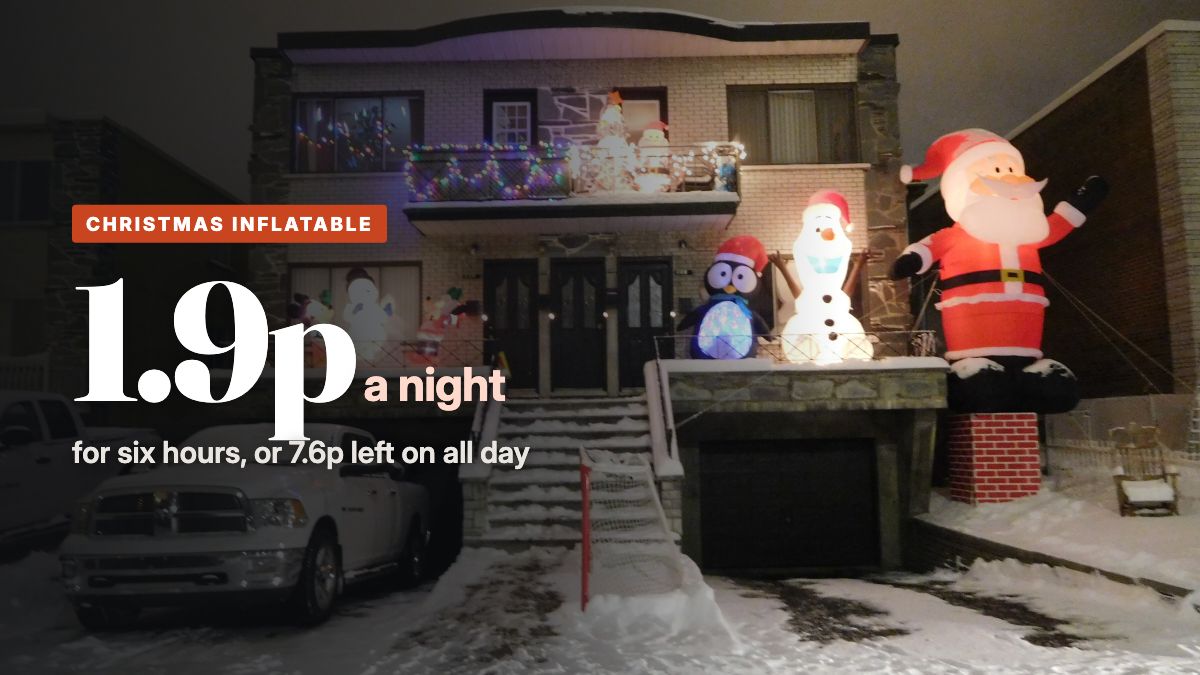
Costway's 1.8 metre light-up Santa runs from a 12 watt power adapter, so a six hour evening uses 0.072 kilowatt hours and costs 1.9p at the Ofgem cap rate of 26.32p per kWh. Left inflated around the clock it costs 7.6p a day, and the 37 days from 1 December to 6 January come to 70p on evenings only or £2.80 if it never goes down. A larger inflatable on an 18 watt adapter costs half as much again.
What an inflatable actually draws
Almost all the power goes on keeping it standing up. A light-up inflatable is a fabric shell with a small fan in its base pushing air in all the time, plus a few LEDs inside to make it glow, and the whole thing sags as soon as the fan stops.
The fans are small. Costway rates the built in blower on its 1.8 metre dog chase Santa at 12 volts and 0.8 amps, which is 9.6 watts, and the power adapter that feeds both the blower and the lights is rated at 12 volts and 1,000 milliamps, so 12 watts is the ceiling for the whole decoration. Gemmy's airblown inflatables ship with adapters rated at 12 volts and 1,500 milliamps, which gives an 18 watt ceiling for the larger models. That puts a medium inflatable in the same bracket as a Wi-Fi router, which sits at around 10 watts all day.
We use 12 watts as the typical figure, which slightly overstates a medium inflatable because the adapter rating is a maximum rather than a measured draw. Older or larger animated pieces with a mains fan and 7 watt bulbs draw more, and the label on the fan tells you how much.
Work it out for your own light-up Christmas inflatable, 1.8m
Type in the wattage from the plate on the back, then your own unit rate. The numbers update as you type.
A night, the season, and leaving it up
| Inflatable | Power | Per hour | Six hour evening | Dusk to dawn, 16 hours | Left up 24 hours | 37 evenings, 1 December to 6 January |
|---|---|---|---|---|---|---|
| Costway 1.8m Santa, blower alone | 9.6 W | 0.25p | 1.5p | 4.0p | 6.1p | 56p |
| Costway 1.8m Santa, adapter limit | 12 W | 0.32p | 1.9p | 5.1p | 7.6p | 70p |
| Larger Gemmy airblown, adapter limit | 18 W | 0.47p | 2.8p | 7.6p | 11.4p | £1.05 |
| Three larger inflatables together | 54 W | 1.4p | 8.5p | 23p | 34p | £3.16 |
A six hour evening covers roughly 4pm to 10pm, when it is dark and people are walking past. The whole of the festive season on evenings only comes to 70p for the typical inflatable, and even leaving it up every hour of those 37 days costs £2.80.
| Appliance | Typical draw | Usage we assume | Per hour (UK) | Per usage (UK) | Per month (UK) | Per hour (US) |
|---|---|---|---|---|---|---|
| Light-up Christmas inflatable, 1.8m | 12 W | per 6 hour evening | 0.32p | 1.9p | 57.5p | 0.22 cents |
Rates: Ofgem cap 1 October to 31 December 2026 at 26.32p per kWh (source), EIA residential average June 2026 at 18.34 cents per kWh (source). Checked 2026-09-22.
Is leaving it up all day worth the extra?
On money alone the gap is small. Running a 12 watt inflatable 24 hours a day rather than six adds £2.10 over the season, about the same as four hours of a 2 kilowatt fan heater.
The case for switching it off sits elsewhere. Gemmy's instructions tell owners to unplug the product when leaving the house, when retiring for the night, or when it is left unattended, which rules out the round the clock setting before cost comes into it. Gemmy's manual for its animated models says not to inflate it in unusually strong winds and to let it deflate until conditions improve, and it notes the fan may stop temporarily when the temperature falls below minus 10 degrees. A British December throws up all three, and an inflatable on a timer that comes up at dusk and goes down at bedtime avoids most of them.
A garden full of them
Front gardens rarely stop at one. Three of the larger 18 watt inflatables together draw 54 watts, so a six hour evening costs 8.5p and the whole season £3.16. That evening uses about as much electricity as ten minutes of a 2 kilowatt fan heater, which costs 53p for a full hour.
Add the LED lights that usually go with them and the total roughly doubles, which still leaves it small. A full house of LED sets inside and out, covering the tree, the front window, the hedge and the gutter, draws about 52 watts, so three inflatables and a house of lights cost much the same as each other. The real outlier on the street is any house still running large old filament sets, because 480 filament bulbs draw almost 200 watts by themselves.
Ways to keep it cheap and standing
- Put it on a plug-in timer for dusk to bedtime. That one change cuts the season from £2.80 to 70p and matches what the instructions ask for.
- Check the adapter rating before buying a second or third. Twelve and 18 watts both cost pennies, but older animated pieces with a mains fan carry bulbs rated at up to 7 watts each, and those add up quickly.
- Tether it with the stakes and lines supplied, because a loose inflatable in a gale is a much bigger problem than the few pence it costs to run.
- After heavy rain or snow, unplug it and shake the water out of the folds before switching back on, as Gemmy's manual advises.
- Keep the adapter and any extension connection off the ground and out of standing water, and use a socket meant for outdoor use.
What this costs in the United States
At the EIA residential average of 18.34 cents per kilowatt hour, a 12 watt inflatable costs 1.3 cents for a six hour evening and 49 cents for 37 evenings. Left inflated every hour of those 37 days it costs $1.95. In California at 34.74 cents the round the clock figure is $3.70, and in Texas at 15.94 cents the evenings only figure is 42 cents.
Common questions
Do Christmas inflatables use a lot of electricity?
No. A typical 1.8 metre inflatable with a fan and LEDs inside runs from a 12 watt adapter, which costs 0.32p an hour and 1.9p for a six hour evening. That is less than one 100 bulb set of old filament fairy lights, which draws 41 watts, and about the same as the broadband router in the hall.
Can you leave Christmas inflatables on all the time?
It costs 7.6p a day to leave a 12 watt inflatable running around the clock, or £2.80 from 1 December to 6 January, so the bill is not the reason to switch it off. The reason is in the instructions. Gemmy, the maker of the Airblown range, tells owners to unplug the product when leaving the house and when going to bed, and it will sag as soon as the fan stops.
Can you leave Christmas inflatables out in the rain?
Outdoor inflatables are sold for indoor and outdoor use, but the makers still ask you to keep the fan and the power cord out of direct water and to plug into a protected outdoor socket. Gemmy's manual warns that heavy rain or snow can weigh an inflatable down, and tells you to unplug it and clear the water from the folds before running it again.
How much does it cost to run an inflatable Santa all night?
A 12 watt inflatable left on from dusk to dawn, about 16 hours in December, uses 0.19 kilowatt hours and costs 5.1p. A larger one on an 18 watt adapter costs 7.6p for the same night. Both are the cost of the electricity only, and Gemmy's instructions ask you to unplug at bedtime.