How much does it cost to charge a mobility scooter per week in the UK?
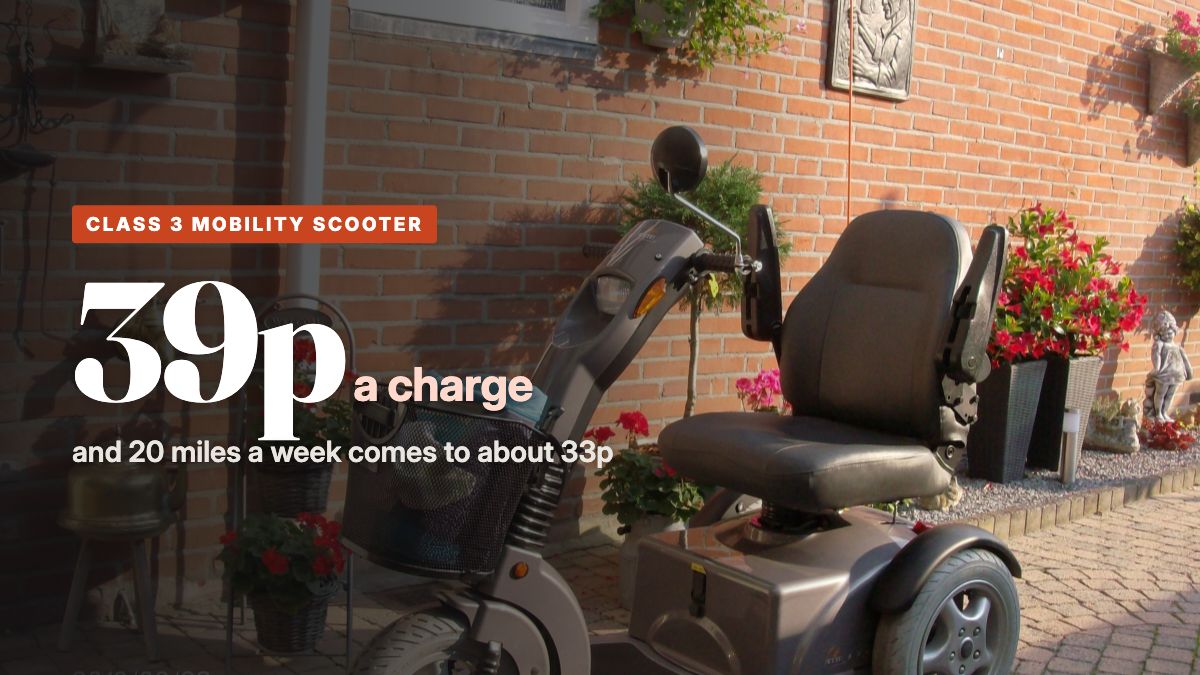
A Class 3 scooter such as TGA's Breeze Midi 4 carries two 12 volt 50Ah batteries, which together hold 1.2 kilowatt hours, and refilling them from flat takes about 1.5 kilowatt hours from the wall once charging losses on sealed lead acid batteries are counted. That costs 39.5p at the Ofgem cap rate of 26.32p per kWh, or about 1.6p a mile over the quoted 24 mile range, so 20 miles of trips a week costs roughly 33p a week and £17.11 a year.
What a mobility scooter battery holds
The cost of charging depends on one number, the energy the battery holds, and you can work it out from the label. Multiply the volts by the amp hours and you get watt hours. Most scooters run two 12 volt batteries wired together to make 24 volts, according to TGA's battery guide, so a pair of 50Ah batteries holds 24 times 50, which is 1,200 watt hours or 1.2 kilowatt hours.
TGA's own range shows how wide the spread is. The Minimo Autofold, a folding boot scooter, has a 24 volt 10.05Ah lithium battery and a 10 mile range. The Zest, a Class 2 pavement scooter, takes two 12 volt 12Ah batteries, or 22Ah for its long range version. The Breeze Midi 4, a Class 3 road scooter with an 8 mph top speed, carries two 12 volt 50Ah batteries for a 24 mile range, or 75Ah for 34 miles.
The socket supplies more than the battery stores, because both the charger and the battery lose some energy as heat. TGA does not publish that loss for its scooters, so we add 25 per cent for sealed lead acid and 15 per cent for lithium as our own working figures. We use the Class 3 pack on sealed lead acid, 1.5 kilowatt hours from the wall, as the everyday figure.
Work it out for your own class 3 mobility scooter charge, 50Ah
Type in the wattage from the plate on the back, then your own unit rate. The numbers update as you type.
What a full charge costs
| Battery pack | Stored | From the wall, lithium | From the wall, lead acid | Full charge, lithium | Full charge, lead acid |
|---|---|---|---|---|---|
| 24V 10Ah, Minimo Autofold | 0.24 kWh | 0.28 kWh | 0.30 kWh | 7.3p | 7.9p |
| 24V 12Ah, Zest | 0.29 kWh | 0.33 kWh | 0.36 kWh | 8.7p | 9.5p |
| 24V 22Ah, Zest long range | 0.53 kWh | 0.61 kWh | 0.66 kWh | 16.0p | 17.4p |
| 24V 50Ah, Breeze Midi 4 | 1.2 kWh | 1.38 kWh | 1.5 kWh | 36.3p | 39.5p |
| 24V 75Ah, Breeze long range | 1.8 kWh | 2.07 kWh | 2.25 kWh | 54.5p | 59.2p |
These are charges from completely flat. If you plug in after every trip, as TGA recommends, each charge only refills what that trip used, often a quarter or a half of the pack, and costs the same share of these figures.
| Appliance | Typical draw | Usage we assume | Per hour (UK) | Per usage (UK) | Per month (UK) | Per hour (US) |
|---|---|---|---|---|---|---|
| Class 3 mobility scooter charge, 50Ah | 1.50 kWh a cycle | per full charge from flat | 4.9p | 39.5p | £3.42 | 3.4 cents |
Rates: Ofgem cap 1 October to 31 December 2026 at 26.32p per kWh (source), EIA residential average June 2026 at 18.34 cents per kWh (source). Checked 2026-09-22.
What a week costs, by how far you ride
The weekly bill follows the miles rather than the number of times you plug in. A Class 3 scooter uses about 0.0625 kilowatt hours a mile from the wall on our lead acid figures, which is 1.5 kilowatt hours spread over the quoted 24 miles, and the folding Minimo uses about 0.028 kilowatt hours a mile.
| Miles a week | Folding lithium scooter | Class 3 road scooter, 50Ah lead acid |
|---|---|---|
| 10 miles, a couple of trips to the shops | 7.3p | 16.5p |
| 20 miles, most days out | 14.6p | 32.9p |
| 40 miles, daily longer trips | 29.2p | 65.8p |
| 20 miles a week for a year | £7.58 | £17.11 |
Hills, cold weather, a heavy load and an ageing battery all cut the range you get from a charge, and every one of them raises the cost per mile.
Why some guides still say 5p to 15p
You will find running cost guides, TGA's among them, saying a full charge costs between 5p and 15p, with up to 15p for a Class 3 scooter with a 50 to 75Ah battery. At today's cap rate, 15p buys 0.57 kilowatt hours, about 47 per cent of what a 50Ah pack holds before any charging losses. Those figures only work at a unit rate of about 12.5p, roughly 47 per cent of the current cap, so treat them as out of date rather than wrong. The electricity is still cheap, just about 2.6 times what those guides suggest for a Class 3 scooter.
The battery costs more than the electricity
The bigger running cost is the battery itself. TGA says most mobility scooter batteries last between 18 months and three years, and puts a replacement at anywhere from £60 for a small Class 2 scooter to £200 or more for a Class 3. Against that, a year of 20 mile weeks on a Class 3 scooter costs £17.11 in electricity.
That changes where the saving is. TGA lists the habits that shorten battery life, which are overcharging, leaving the battery flat for long periods, regularly running it down to empty, and storing the scooter somewhere very hot or very cold. Avoiding those is worth more than any tariff, because stretching a £200 battery from 18 months to three years saves more each year than the electricity costs in total.
Where the real savings are
- Charge after each trip and disconnect the charger when it shows full, which is TGA's advice for battery life.
- Do not leave the battery flat for days, and avoid running it to empty out of habit.
- Keep the scooter indoors or in a dry, sheltered spot, away from the worst of the cold.
- Use the charger supplied or one the manufacturer recommends.
- Check the tyre pressures, because soft tyres take more energy for every mile.
- Ignore tariff tricks. On a full Class 3 charge a unit rate 10p cheaper saves about 15p.
What this costs in the United States
At the EIA residential average of 18.34 cents per kilowatt hour, a full charge of a 50Ah lead acid pack costs about 27.5 cents, and 20 miles a week costs 22.9 cents a week and $11.92 a year. In California at 34.74 cents that year costs $22.58, and in Texas at 15.94 cents it costs $10.36.
Common questions
How much does it cost to charge a mobility scooter?
Between about 7.3p and 59p for a full charge from flat, depending on the size of the battery pack. A small folding scooter with a 24 volt 10Ah lithium battery sits at the bottom of that range, a Class 3 road scooter with two 12 volt 50Ah batteries costs about 39p, and the 75Ah long range packs cost the most. Topping up after a short trip costs a fraction of that.
How much does it cost to charge a mobility scooter overnight?
The same as charging it at any other time on a standard tariff, because the battery only takes what it needs to fill up. A Class 3 scooter with a flat 50Ah pack costs about 39p to refill, and one that was half used costs about half that. TGA advises disconnecting the charger once the battery is full rather than leaving it plugged in for long periods.
How long does it take to charge a mobility scooter battery?
A rough guide is the battery's amp hours divided by the charger's amps. A 50Ah pack on an 8 amp charger needs at least six and a quarter hours, a 10Ah folding scooter battery on a 2.5 amp charger about four hours, and chargers slow down towards the end, so the manual's own figure is the one to follow.
Do mobility scooters use lithium batteries?
Some do. TGA's battery guide says most scooters use sealed lead acid batteries, either AGM or gel, while some newer scooters use lithium, including its whole range. Lithium packs lose a little less energy while charging, so on our figures a full charge of the same size pack costs about 3p less, which matters far less than how long the battery lasts.