How much does it cost to run a vacuum cleaner for an hour in the UK?
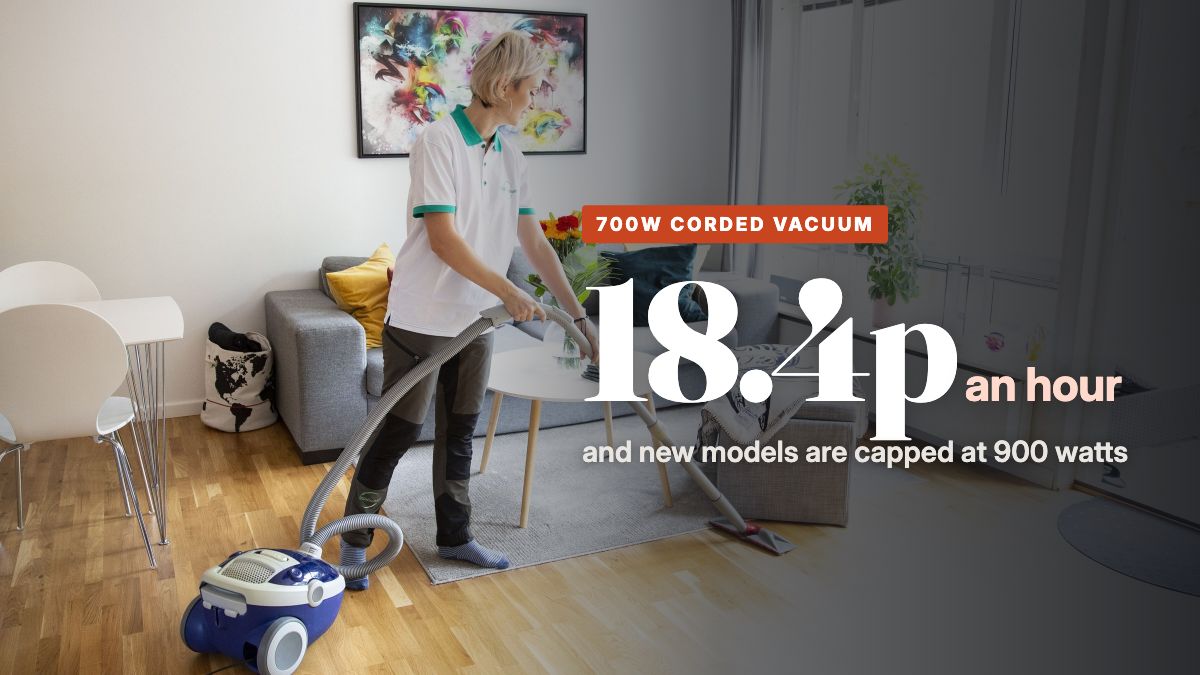
A 700 watt corded vacuum cleaner such as the Shark NZ780UKT uses 0.7 kilowatt hours in an hour and costs 18.4p at the Ofgem cap rate of 26.32p per kWh. An hour a week for a year comes to £9.58. Ecodesign rules have kept new mains vacuums below 900 watts since September 2017, so the most a current model can cost is about 23.7p an hour, and a full charge of a cordless vacuum costs around 2.2p.
What a vacuum cleaner draws
A corded vacuum cleaner costs 18.4p an hour if it is rated at 700 watts, and that is a fair middle figure for a machine bought in the last few years. Shark rates its Anti Hair Wrap Plus upright, the NZ780UKT, at 700 watts, and Numatic puts the motor in the Henry HVR160 at 620 watts.
Those numbers are lower than many people remember because the law changed. The ecodesign regulation for vacuum cleaners required the rated input power of new mains models to be under 1,600 watts from 1 September 2014, and under 900 watts from 1 September 2017. The same rules set minimum dust pick up standards of 0.75 on carpet and 0.98 on hard floor from 2017, so manufacturers had to keep the cleaning while cutting the power. If your vacuum is older than 2014, it may be rated well above anything sold today.
Work it out for your own corded vacuum cleaner
Type in the wattage from the plate on the back, then your own unit rate. The numbers update as you type.
What an hour costs, machine by machine
| Vacuum | Rating | Per hour | Half an hour | An hour a week for a year |
|---|---|---|---|---|
| Numatic Henry HVR160 | 620 W | 16.3p | 8.2p | £8.49 |
| Shark Anti Hair Wrap Plus NZ780UKT | 700 W | 18.4p | 9.2p | £9.58 |
| Legal limit for new models since 2017 | under 900 W | 23.7p | 11.8p | £12.32 |
| Legal limit from 2014 to 2017 | under 1,600 W | 42.1p | 21.1p | £21.90 |
Most households vacuum for less than an hour at a time, so the half hour column is closer to a typical session. The regulation itself works on the assumption of 50 one hour cleaning sessions a year in a home of 87 square metres, and caps the annual energy of a new mains vacuum at 43 kilowatt hours on that basis, which is £11.32 a year at the current cap for the least efficient machine allowed on sale.
| Appliance | Typical draw | Usage we assume | Per hour (UK) | Per usage (UK) | Per month (UK) | Per hour (US) |
|---|---|---|---|---|---|---|
| Corded vacuum cleaner | 700 W | per hour of vacuuming | 18.4p | 18.4p | 79.8p | 12.8 cents |
Rates: Ofgem cap 1 October to 31 December 2026 at 26.32p per kWh (source), EIA residential average June 2026 at 18.34 cents per kWh (source). Checked 2026-09-22.
Cordless vacuums, per charge
A cordless stick vacuum draws far less than a corded one, and the cost is set by its battery rather than the hours. Numatic gives the Henry Quick a 300 watt vacuum motor and a 49.6 watt brush motor, with 14 minutes of runtime on its high setting. Running both motors for those 14 minutes uses about 0.082 kilowatt hours, which is 2.2p at the cap rate. The Henry Cordless has a 250 watt motor and 20 minutes on high, which works out at about 0.083 kilowatt hours and lands on the same figure.
Numatic does not publish the battery capacity in watt hours, so these are worked from the motor rating and the runtime, and a little more than this is lost as heat in the charger while the battery fills. Even allowing for that, three full charges a week costs about £3.37 over a year. Shark's Stratos IZ400UKT is rated at 309 watts and takes three and a half hours to charge, which puts it in the same band.
On the question of whether cordless vacuums use more electricity, the answer is the other way round. Fourteen minutes with a 700 watt corded machine uses about 0.16 kilowatt hours, twice the Henry Quick figure for a whole battery. Battery powered vacuums sit outside the ecodesign power limit altogether, although in practice the battery keeps their draw well below it.
Robot vacuums
A robot vacuum works on the same principle with a smaller motor and a longer run. The Roborock Qrevo S Pro carries a 75 watt hour battery, so a full recharge costs about 2.0p, and the docking station adds its own use for emptying, washing and drying. That second part can cost more than the cleaning, and it is worked through in our guide to what a robot vacuum costs each month.
Against the rest of the housework
An hour of vacuuming at 700 watts uses about the same electricity as one 40 degree load in a washing machine, which runs at around 0.68 kilowatt hours. It is about a quarter of an hour of ironing at the full 2,600 watt rating of a modern steam iron. Of the regular cleaning jobs in a home, the vacuum is one of the cheapest to run.
Ways to cut the cost
The savings on a vacuum are small, so the useful moves are the ones that save time as well as electricity. If you still use a machine from before 2014, an hour a week on a 1,600 watt motor costs about £12.32 a year more than the same hour on a 700 watt one, which is a reason to choose a lower rating when it needs replacing rather than a reason to replace it early.
- Empty the bin or change the bag before it is full, because a clogged machine needs more passes over the same patch of carpet.
- Clean or rinse the filters as the manual says, for the same reason.
- On a cordless vacuum, use the low or eco setting for hard floors and save the high setting for carpets, since the Henry Quick lasts 70 minutes on low against 14 on high.
- Vacuum in one session and move room to room, rather than getting the machine out for each room on a different day.
What this costs in the United States
At the EIA residential average of 18.34 cents per kilowatt hour, an hour with a 700 watt vacuum costs 12.8 cents and an hour a week for a year about $6.68. In California, at 34.74 cents, the same hour is 24.3 cents and the year about $12.65, and in Texas at 15.94 cents it is 11.2 cents an hour and about $5.80 a year.
Common questions
How much does it cost to run a vacuum for an hour?
At the cap rate of 26.32p per kWh, a 620 watt Henry costs 16.3p an hour, a 700 watt Shark upright 18.4p and a machine at the 900 watt legal limit 23.7p. A vacuum bought between 2014 and 2017 may be rated up to 1,600 watts, which is 42.1p an hour, and older ones can be higher still.
How much electricity does a vacuum cleaner use?
Its rating in kilowatts for every hour it runs, so 0.7 kilowatt hours an hour for a 700 watt machine. The ecodesign rules assume 50 one hour cleaning sessions a year and cap the yearly use of a new mains vacuum at 43 kilowatt hours, which is £11.32 at the current cap.
Do cordless vacuums use more electricity?
No, they use less. A cordless stick runs on 250 to 350 watts against 620 to 900 for a corded machine, and a full battery on the Henry Quick or Henry Cordless works out at about 0.08 kilowatt hours, roughly 2.2p a charge. Fourteen minutes on a 700 watt corded vacuum uses about twice that.
How much does it cost to charge a cordless vacuum in the UK?
About 2.2p for a full charge of a stick vacuum with a 250 to 350 watt motor, plus a little lost as heat in the charger. Three full charges a week come to about £3.37 a year.