How much does it cost to run a 3D printer per hour in the UK?
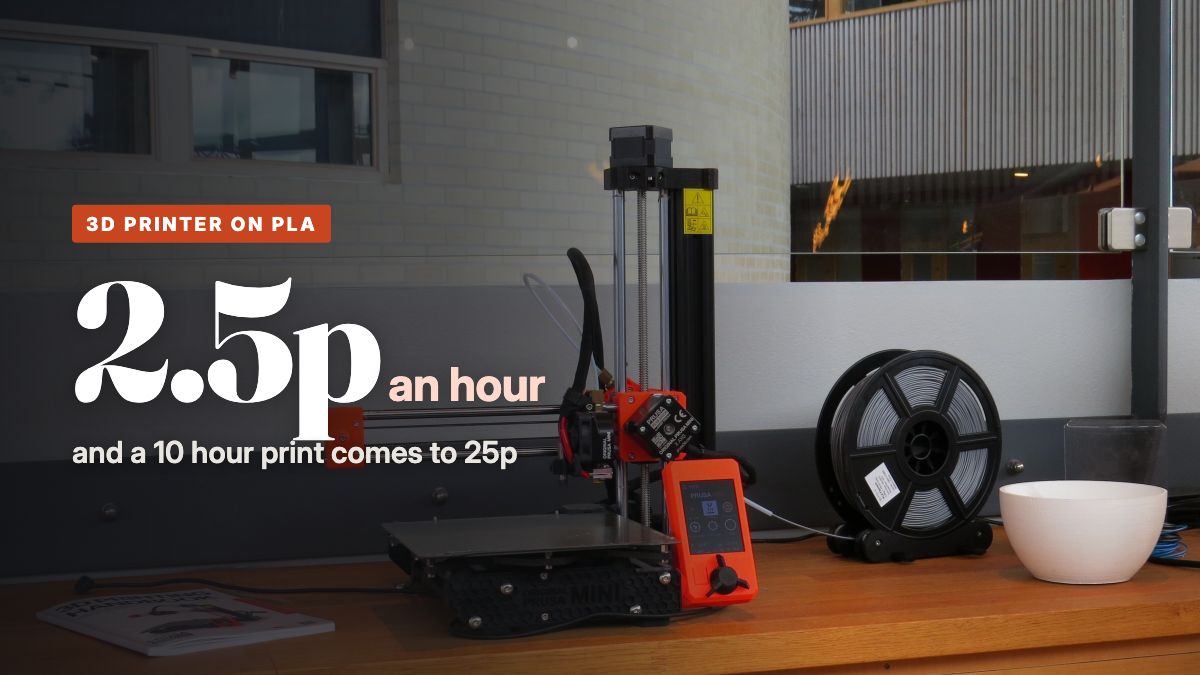
A typical home 3D printer printing PLA averages 80 to 110 watts, so an hour costs between 2.1p and 2.9p at the Ofgem cap rate of 26.32p per kWh. Bambu Lab measures its A1 at 95 watts, which comes to 10p for a four hour print and 60p for 24 hours. ABS and other high temperature materials draw more, up to 200 watts on an open frame printer, and the start of every print briefly pulls far more while the bed heats up.
What a 3D printer draws
The power supply rating on a 3D printer tells you very little about what it costs to run. Bambu Lab rates its A1 at 1300 watts and its P1S and X1C at 1000 watts at 220 volts, close to UK mains, but those ratings describe the power supply, and the heavy draw is confined to the first few minutes of a print while the heated bed warms up. Once the bed and nozzle are at temperature the printer only has to top up the heat it loses, and the average falls to a small fraction of the rating.
Bambu Lab publishes measured averages for each of its printers. Printing PLA, the A1 mini averages 80 watts, the A1 95 watts, the P1S and X1C 105 watts and the P1P 110 watts. The newer A2L was measured at 0.145 kilowatt hours over an hour of PLA printing, which is 145 watts. The large dual nozzle H2D averages 197 watts on PLA, and the X2D 250 watts. Prusa Research gives a similar answer for its own machines, measuring an MK series printer in a 26 degree room at 80 watts printing generic PLA and 120 watts printing generic ABS.
We cost a home printer at 95 watts, the A1 figure on PLA, because it sits in the middle of the desktop printers most people buy. The calculator lets you put in your own model's figure.
Work it out for your own 3D printer
Type in the wattage from the plate on the back, then your own unit rate. The numbers update as you type.
Per hour, per print and per day by printer
| Printer and material | Average draw | Per hour | Four hour print | 24 hours |
|---|---|---|---|---|
| Bambu Lab A1 mini, PLA | 80 W | 2.11p | 8.4p | 51p |
| Prusa MK series, PLA | 80 W | 2.11p | 8.4p | 51p |
| Bambu Lab A1, PLA | 95 W | 2.50p | 10.0p | 60p |
| Bambu Lab P1S or X1C, PLA | 105 W | 2.76p | 11.1p | 66p |
| Prusa MK series, ABS | 120 W | 3.16p | 12.6p | 76p |
| Bambu Lab P1S, ABS | 140 W | 3.68p | 14.7p | 88p |
| Bambu Lab H2D, PLA | 197 W | 5.19p | 20.7p | £1.24 |
| Bambu Lab A1, ABS | 200 W | 5.26p | 21.1p | £1.26 |
| Bambu Lab X2D, PLA | 250 W | 6.58p | 26.3p | £1.58 |
| Bambu Lab H2D, polycarbonate | 395 W | 10.40p | 41.6p | £2.50 |
Most of Bambu Lab's averages come from test prints of about 15 to 18 minutes, which include the warm up at the start. On a print lasting several hours the warm up is a much smaller share of the job, so treat these figures as a fair ceiling for long prints on PLA.
| Appliance | Typical draw | Usage we assume | Per hour (UK) | Per usage (UK) | Per month (UK) | Per hour (US) |
|---|---|---|---|---|---|---|
| 3D printer | 95 W | per 4 hour PLA print | 2.5p | 10.0p | £1.30 | 1.7 cents |
Rates: Ofgem cap 1 October to 31 December 2026 at 26.32p per kWh (source), EIA residential average June 2026 at 18.34 cents per kWh (source). Checked 2026-09-22.
The material matters more than the model
What you print with moves the bill further than which printer you own. On the open frame A1, switching from PLA to ABS takes the average from 95 to 200 watts, because ABS needs a far hotter bed and nozzle and an open printer loses that heat to the room. The enclosed P1S holds its heat in, and the same change only takes it from 105 to 140 watts. Polycarbonate goes higher again, to 395 watts on the H2D and 550 watts on the X2D.
The temperature of the room plays the same part. Prusa measured its 80 and 120 watt figures at 26 degrees, warmer than most UK spare rooms in winter, so a printer working in a cold garage or loft has to put in more heat to keep the bed at temperature. Moving it to a warmer room costs nothing and takes some of that load off.
Idle and standby, the hours nobody counts
A 3D printer left switched on between jobs keeps its screen, its control board and its Wi-Fi running. Bambu Lab measures the A1 at 4.1 to 5.4 watts sitting idle on Wi-Fi, the P1S at 5.8 to 6 watts and the X1C at 8.7 to 9.9 watts. Left on all year at the top of its range, the A1 costs £12.45 doing nothing, and the X1C £22.83.
The large H2D idles at 25 to 27 watts, which comes to £62.25 a year if it is never switched off. For a hobbyist printing a few hours a week, that is more than all of the actual printing costs, which makes the plug the cheapest upgrade a large printer owner can make. Bambu Lab's AMS filament changer adds about 1 watt of its own on standby.
Long prints, overnight and per month
Long prints are cheap on electricity. A 24 hour PLA print on the A1 costs 60p, and an overnight eight hour job 20p. Three four hour prints a week add up to about 5 kilowatt hours a month, which is £1.30, and even a printer kept busy eight hours every day uses about 23 kilowatt hours a month and costs £6.07.
To price a whole print, add the filament to the electricity. The slicer tells you how many grams a print uses, and dividing what you paid for a one kilogram spool by 1,000 gives the cost per gram. For PLA on a desktop printer the filament usually costs more than the electricity, so a failed print that has to be thrown away wastes more in plastic than in power.
What actually lowers the cost
- Switch the printer off at the wall when the day's printing is done, since idling all year can cost more than the printing on a large machine.
- Print in PLA where the part allows it, because ABS and polycarbonate can double or quadruple the average draw.
- Use an enclosure, or an enclosed printer, for high temperature materials, which is why the P1S needs 140 watts for ABS where the open A1 needs 200.
- Keep the printer in a warm room rather than a cold garage, so the bed is not fighting the air around it.
- Group small parts into one job, since every print starts with a warm up, the most power hungry part of the job.
What this costs in the United States
At the EIA residential average of 18.34 cents per kilowatt hour, a 95 watt printer costs 1.7 cents an hour on PLA, 7.0 cents for a four hour print and 41.8 cents for 24 hours. Three four hour prints a week come to about 90 cents a month.
Common questions
Does a 3D printer use a lot of electricity?
Very little for what it does. A Bambu Lab A1 printing PLA averages 95 watts, which is 2.5p an hour, and Prusa measures its MK printers at 80 watts on PLA, 2.1p an hour. That is less than a 65 inch television, though ABS and large dual nozzle printers can draw two to four times as much.
How much does it cost to run a 3D printer for 24 hours?
About 60p for a Bambu Lab A1 printing PLA for a full day, and 51p for a Prusa MK printer. The same day printing ABS on the A1, at 200 watts, costs £1.26, and a large Bambu Lab H2D printing polycarbonate at 395 watts costs £2.50.
Can I leave my 3D printer on all the time?
It costs more than people expect when the printer is large. Bambu Lab measures the A1 at 4.1 to 5.4 watts sitting idle on Wi-Fi, which is £12.45 a year if it is never switched off, while the H2D idles at 25 to 27 watts, £62.25 a year. Switching off at the wall between sessions removes all of it.
How much electricity does a 3D printer use per month?
Three four hour PLA prints a week on a 95 watt printer use about 5 kilowatt hours a month, which costs £1.30. Printing eight hours every day uses about 23 kilowatt hours and costs £6.07 a month.