How much do Christmas lights cost to run per day in the UK?
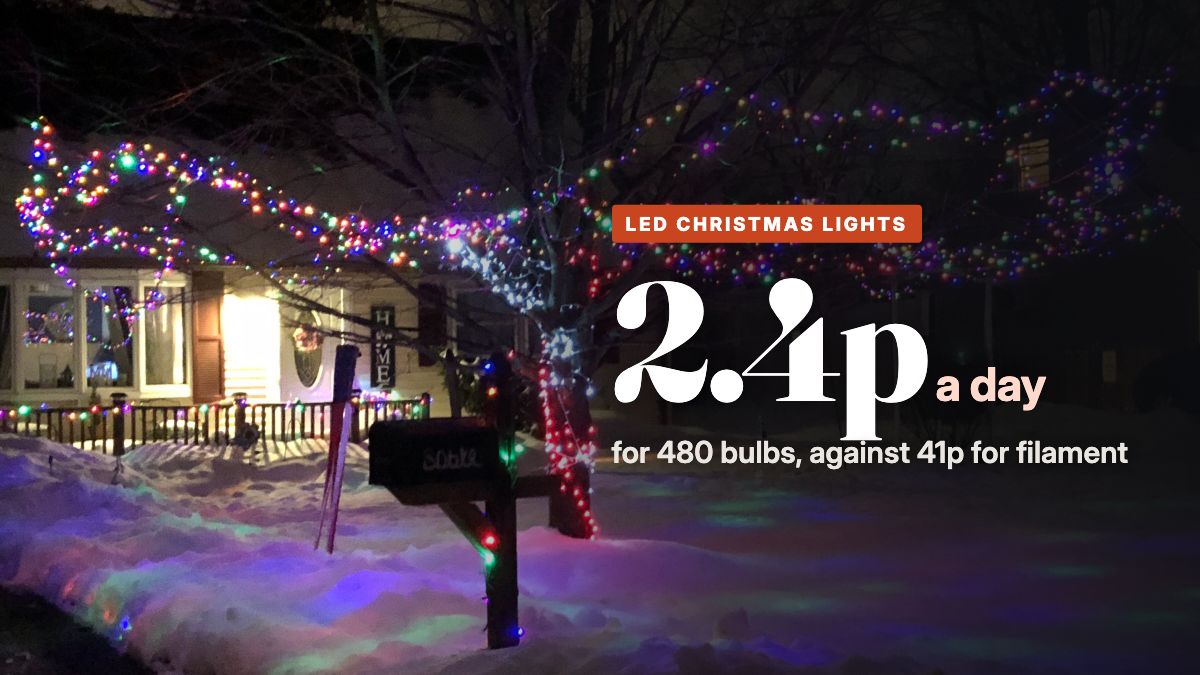
A 480 bulb LED fairy light set rated at 11.52 watts uses 0.09 kilowatt hours over an eight hour evening, which costs 2.4p at the Ofgem cap rate of 26.32p per kWh and 90p across the 37 days from 1 December to 6 January. A 1,000 bulb LED cluster set on the tree at 24 watts costs 5.1p a day, while 480 old filament bulbs would cost 41p a day and £15.33 over the same season.
What a set of Christmas lights draws
Christmas lights are one of the few things in a British house where the number on the box tells you almost nothing about the bill, because the bulb count and the wattage have come apart completely since LEDs took over.
Festive's 480 bulb multifunction fairy lights, which stretch to 38.3 metres, are rated at 11.52 watts. Their 1,000 bulb cluster set for a tree is rated at 24 watts. Festive Lights publishes the ratings for its own ConnectGo range, where a 5 metre set of fairy lights draws 0.68 watts and a 20 metre cluster of 1,500 LEDs draws 4.2 watts, so that last set carries half as many bulbs again as the Festive cluster for about a sixth of the power.
The old filament mini lights are where the cost lives. A classic set of 100 incandescent mini bulbs is rated at 41 watts, which is 0.41 watts a bulb against roughly 0.024 watts a bulb for the 480 LED set. That makes each filament bulb about 17 times as thirsty as an LED one.
We use the 480 bulb LED set at 11.52 watts as the everyday figure, with an eight hour evening because that is what the built in timer on the Festive set gives you.
Work it out for your own LED Christmas lights, 480 bulbs
Type in the wattage from the plate on the back, then your own unit rate. The numbers update as you type.
What a day costs, set by set
| Lights | Power | Per hour | Eight hour evening | Left on 24 hours | 1 December to 6 January, evenings |
|---|---|---|---|---|---|
| ConnectGo 5m fairy lights | 0.68 W | 0.018p | 0.14p | 0.43p | 5p |
| ConnectGo 5m icicle lights | 2.73 W | 0.07p | 0.57p | 1.7p | 21p |
| ConnectPro 5m string lights | 3.5 W | 0.09p | 0.74p | 2.2p | 27p |
| ConnectGo 20m cluster, 1,500 LEDs | 4.2 W | 0.11p | 0.88p | 2.7p | 33p |
| Festive fairy lights, 480 LEDs | 11.52 W | 0.30p | 2.4p | 7.3p | 90p |
| Festive cluster, 1,000 LEDs | 24 W | 0.63p | 5.1p | 15.2p | £1.87 |
| Filament mini lights, 100 bulbs | 41 W | 1.1p | 8.6p | 26p | £3.19 |
| Filament mini lights, 480 bulbs | 196.8 W | 5.2p | 41p | £1.24 | £15.33 |
The season column runs the 37 evenings from 1 December to Twelfth Night, which is when most trees go up and come down. If yours goes up in late November, add a fifth to it.
| Appliance | Typical draw | Usage we assume | Per hour (UK) | Per usage (UK) | Per month (UK) | Per hour (US) |
|---|---|---|---|---|---|---|
| LED Christmas lights, 480 bulbs | 12 W | per 8 hour evening on the built in timer | 0.30p | 2.4p | 73.6p | 0.21 cents |
Rates: Ofgem cap 1 October to 31 December 2026 at 26.32p per kWh (source), EIA residential average June 2026 at 18.34 cents per kWh (source). Checked 2026-09-22.
A whole house, front garden included
Most people searching this question are not lighting one tree, so here is a full display priced the same way. A 1,000 bulb cluster on the tree at 24 watts, the 480 bulb set around the front window at 11.52 watts, the 20 metre cluster along the hedge at 4.2 watts, two icicle sets under the gutter at 5.46 watts between them, a light-up reindeer and a string set on the porch at 3.5 watts each, and a 12 watt light-up inflatable on the lawn.
That whole house draws 64.18 watts. Eight hours of it uses 0.51 kilowatt hours, which costs 14p an evening and £5.00 from 1 December to 6 January. A single 480 bulb filament set from the 1990s, on its own, costs £15.33 over the same 37 evenings, so the entire LED house costs about a third of what one old set did.
Leave that display on 24 hours a day and it costs 41p a day and £15.00 for the season. That is still less than one hour of a 2 kilowatt oil filled radiator at 53p, but it is three times the timer figure for no extra sparkle during daylight.
Which setting is cheapest
Multifunction sets come with eight or so modes, and they do not cost the same. When Which? measured the running cost of each setting on one set, slow glow and twinkle came out at under half the cost of plain steady on, chasing and flashing came out a little under half, and the wave setting cost almost the same as steady.
The reason is that a mode which keeps the LEDs dark or dimmed for part of each second uses less energy over the hour. On a single 480 bulb set that saving is a fraction of a penny a night, so pick the mode you like looking at. On a big outdoor display running every evening for five weeks, slow glow can take a noticeable slice off the season total.
If you still have filament lights
The case for replacing old sets depends on how many bulbs they carry. A 100 bulb filament set at 41 watts costs 8.6p for an eight hour evening and £3.19 over the season. A 100 bulb LED set at roughly the same 0.024 watts a bulb would cost 19p for the whole season, so the saving is about £3.01 a year.
That makes a small old set a slow payback, and many people reasonably keep using it for the warm colour until it fails. A large filament display is a different matter, because 480 bulbs cost £15.33 a season and the LED replacement costs 90p. Swap the biggest set first.
Where the real savings are
- Use the timer. The Festive set runs eight hours on and 16 off by itself, and that one setting decides whether your season costs a third or the full 24 hour figure.
- Read the watts on the transformer or the box rather than the bulb count. The 1,500 bulb ConnectGo cluster draws about a sixth of the power of the 1,000 bulb Festive one.
- Choose slow glow or twinkle for the outdoor display that runs longest.
- Retire large filament sets before small ones, because the saving grows with every bulb.
- Do not worry about the LED tree in the living room. At 5.1p for a full evening it uses about a third of what a 120 watt television beside it uses over five hours of viewing.
What this costs in the United States
At the EIA residential average of 18.34 cents per kilowatt hour, a 480 bulb LED set on an eight hour timer costs 1.7 cents a day and 63 cents for the 37 evenings. The whole house display above costs 9.4 cents an evening and $3.48 for the season. In California at 34.74 cents the same display comes to $6.60, and in Texas at 15.94 cents it comes to $3.03. A 480 bulb filament set, for comparison, costs 29 cents an evening and $10.68 for the season at the national average.
Common questions
Do Christmas lights use a lot of electricity?
LED sets use very little. A 480 bulb set at 11.52 watts draws about a tenth of what a 120 watt television does, so an eight hour evening costs 2.4p. Old filament sets are a different story, because each filament bulb draws about 0.41 watts against 0.024 watts for an LED, and 480 of them cost 41p for the same evening.
How much does it cost to run Christmas lights 24/7?
A 480 bulb LED set left on around the clock uses 0.28 kilowatt hours a day, which is 7.3p a day and £2.69 from 1 December to 6 January. A 24 watt cluster set of 1,000 LEDs on the tree costs 15p a day and £5.61 for the season. Using the eight hour timer that most sets have built in cuts both figures by two thirds.
How much do Christmas lights cost per hour?
A 480 bulb LED set costs 0.30p an hour and a 1,000 bulb LED cluster set on the tree costs 0.63p. A 100 bulb filament set at 41 watts costs 1.1p an hour, so one small old set costs more than four large LED sets put together.
Which setting on Christmas lights is cheapest to run?
Slow glow and twinkle. In a Which? test those two settings cost well under half as much per hour as leaving the lights on steady, chasing and flashing came in a little higher, and the wave setting cost almost the same as steady on. On a 480 bulb LED set the steady setting is only 0.30p an hour to begin with, so the saving matters most on large displays.