What does an electric radiator cost per hour, and is it cheaper than gas?
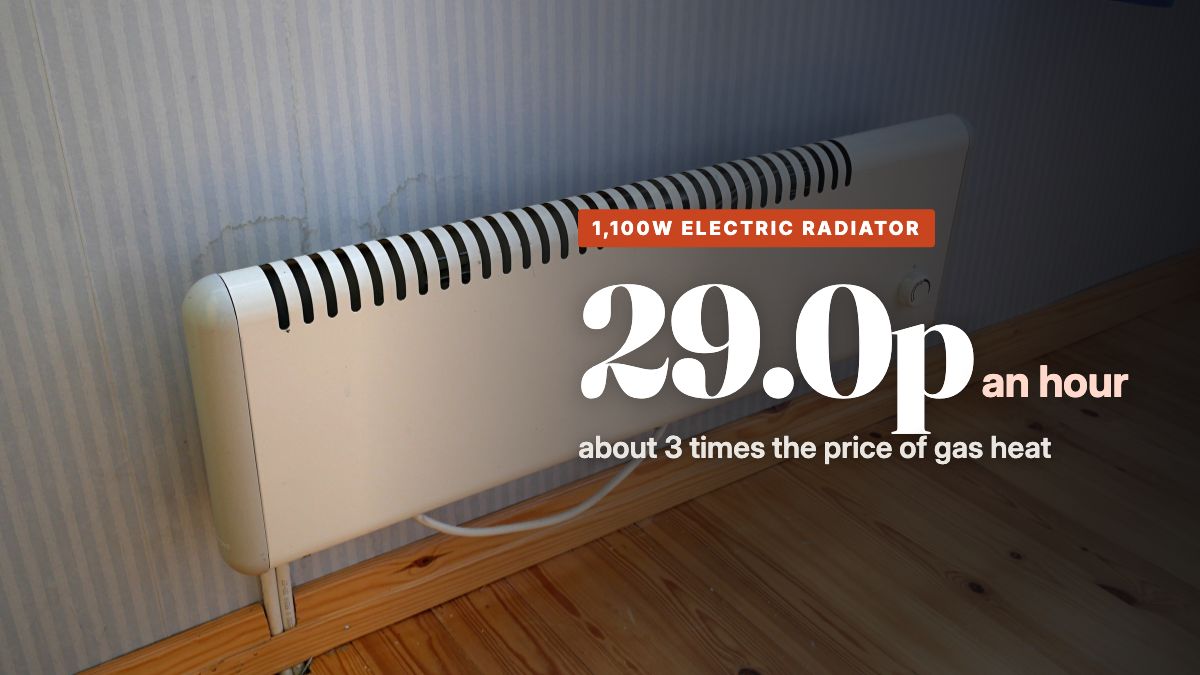
An electric radiator costs its wattage at the unit rate, so Haverland's 1,100 watt RC7W+, sized for a 13 square metre room, costs 29.0p an hour at full output at the Ofgem cap rate of 26.32p per kWh, and its 800 watt model for a 10 square metre bedroom costs 21.1p. Once the room is warm the thermostat cycles it, so the real cost per hour is lower. Gas central heating makes the same heat for about 8.9p a kilowatt hour, roughly a third of the electric price.
What a wall mounted electric radiator draws
A wall mounted electric radiator is a heating element inside an aluminium or steel body, with a thermostat that switches the element on and off to hold the room at the temperature you set. Every watt it draws becomes heat in the room, and the plate rating is the most it can draw in an hour.
Makers size them by the room. Haverland's RCW+ range runs from the 450 watt RC3W+ for a 5 square metre room, through the 800 watt RC5W+ for 10 square metres and the 1,100 watt RC7W+ for 13 square metres, up to the 1,700 watt RC11W+ for a 20 square metre room. Its other ranges cover a similar span, with the Designer RCTT running from 500 to 1,800 watts. That works out at roughly 80 to 90 watts for every square metre of floor, which is a useful rule for checking whether a radiator in your own home is the right size.
Work it out for your own electric radiator
Type in the wattage from the plate on the back, then your own unit rate. The numbers update as you type.
The cost per hour for each size
At the current cap rate of 26.32p per kWh, Haverland's 1,100 watt radiator costs 29.0p an hour at full output. The last column shows the same radiator if the thermostat holds it on for half of each hour once the room is warm, which is an illustration rather than a measured figure, since the real share depends on the room, the weather and the setting.
| Radiator | Room it is sized for | Per hour at full output | Five hour evening at full | Five hours on half the time |
|---|---|---|---|---|
| 450 W | 5 m², a box room or bathroom | 11.8p | 59.2p | 29.6p |
| 800 W | 10 m², a small bedroom | 21.1p | £1.05 | 52.6p |
| 1,100 W | 13 m², a double bedroom | 29.0p | £1.45 | 72.4p |
| 1,400 W | 16 m², a small living room | 36.8p | £1.84 | 92.1p |
| 1,700 W | 20 m², a living room | 44.7p | £2.24 | £1.12 |
| Appliance | Typical draw | Usage we assume | Per hour (UK) | Per usage (UK) | Per month (UK) | Per hour (US) |
|---|---|---|---|---|---|---|
| Electric radiator | 1100 W | per hour at full output | 29.0p | 29.0p | £43.91 | 20.2 cents |
Rates: Ofgem cap 1 October to 31 December 2026 at 26.32p per kWh (source), EIA residential average June 2026 at 18.34 cents per kWh (source). Checked 2026-09-22.
A whole flat on electric radiators
Many flats and some houses in Britain have no gas at all, and the radiators are the heating. Take a flat with a 20 square metre living room, a 13 square metre bedroom, a 10 square metre second bedroom and a 5 square metre bathroom, fitted with the matching Haverland sizes. That is 4,050 watts of radiators, and if they run at half output on average across a six hour heating day they use about 12.2 kilowatt hours, which costs £3.20 a day at the current cap.
The same 12.2 kilowatt hours of heat from a gas boiler would cost about £1.08, because boiler heat costs about 8.9p a kilowatt hour once you allow for efficiency, against 26.32p from the socket. Over a heating season of 182 days that is roughly £582 on electric radiators against £196 on gas.
The gas standing charge narrows the gap a little. A home with no gas supply does not pay the 29.68p a day that a gas connection costs, which is £108 a year. Set against the difference in unit rates, that only tips the balance towards electric radiators for a home using less than about 620 kilowatt hours of heat a year, which the flat above would use in 51 days of winter.
The thermostat and the smart radiator claims
Electric radiators are often sold as smart or efficient, and the honest version of that claim is about control rather than conversion. Haverland's RCW+ radiators have a digital chrono thermostat accurate to 0.2°C, a programme that covers every hour of the week, separate comfort, economy and frost settings and an open window function.
None of that makes a kilowatt hour of electricity produce more heat. What a good thermostat and programme do is stop the radiator heating a room nobody is in, and stop it overshooting the temperature you asked for, and those are where the savings on a real bill come from. A cheap convector with a crude dial and no timer, left on all evening, will cost more than a well programmed radiator of the same wattage simply because it runs for more hours.
Spending less with electric radiators
- Programme each radiator for the hours its room is used, so the bedrooms are warm at night and the living room in the evening, rather than holding the whole home at temperature all day.
- Turn the set temperature down by a degree, since every hour the element does not have to run is 29.0p saved on a 1,100 watt radiator.
- Size the radiator to the room. One that is too small for the room runs flat out for hours, and Haverland's sizing works out at roughly 80 to 90 watts a square metre.
- Keep doors closed between heated and unheated rooms, so the warm air you paid for stays where the thermostat is measuring it.
- Check your tariff. If you rely on electric heating, a time of use tariff with a cheaper overnight or off peak window can change the cost far more than the radiator ever will.
What it costs in the United States
At the EIA residential average of 18.34 cents per kilowatt hour, a 1,100 watt electric radiator costs 20.2 cents an hour at full output and $1.01 for a five hour evening. In California at 34.74 cents the same radiator costs 38.2 cents an hour, and in Texas at 15.94 cents it costs 17.5 cents.
Common questions
Are electric radiators cheaper than gas central heating?
No, not at the current cap rates. Electric heat costs 26.32p a kilowatt hour and boiler heat costs about 8.9p once you allow for efficiency, so the same warmth from electric radiators costs roughly 3 times as much. Dropping gas saves the standing charge of £108 a year, which only makes up the difference for a home using less than about 620 kilowatt hours of heat a year.
Can you leave electric radiators on all the time?
You can, and modern ones with an electronic thermostat will switch themselves off whenever the room is at temperature, but you pay for every hour the room is held warm. Programming them to heat the rooms in the hours they are used costs less than holding the whole home at temperature around the clock.
Are electric radiators expensive to run?
Per hour they cost the same as any electric heater of the same wattage, from 11.8p an hour for a 450 watt box room radiator to 44.7p for a 1,700 watt living room one at full output. They become expensive when they are the main heating for a whole home, because electric heat costs about 3 times as much as gas.
Is it cheaper to use an electric heater in one room?
Yes, if the alternative is heating the whole house to warm that one room. An hour of a 1,100 watt radiator costs 29.0p, while an hour of a gas boiler running at around 10 kilowatts costs about 80p. Once two or three rooms need heat, the boiler is the cheaper way to do it.
Are electric radiators cheaper than storage heaters?
Usually not on running cost. A storage heater charges overnight on a cheaper off peak rate such as Economy 7 and releases the heat the next day, while a panel radiator heats at the moment you use it on the standard rate. A panel radiator can win in a well insulated flat where heat is needed for a few evening hours, since a storage heater charged the night before can be empty by the evening.