How much does it cost to run a heated towel rail in the UK?
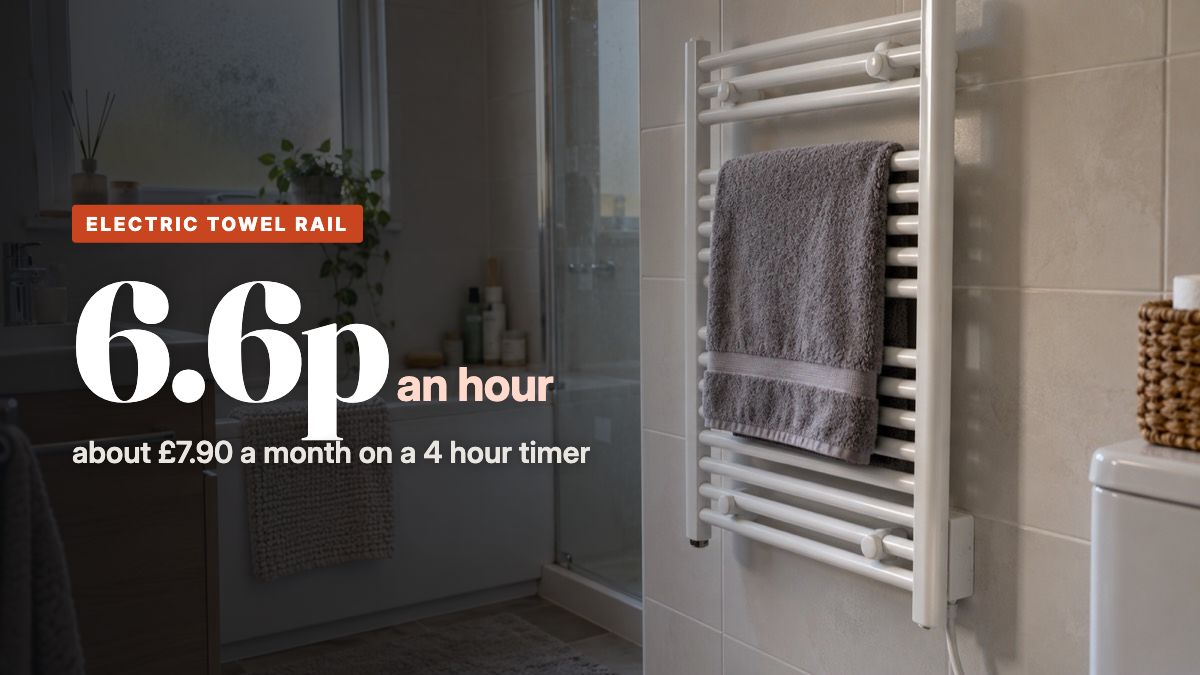
Electric towel rails are low power heaters, between 120 and 400 watts across Dimplex's TRM range, so a typical 250 watt rail costs 6.6p an hour at the Ofgem cap rate of 26.32p per kWh. Four hours a day on the timer comes to about 26.3p a day and £7.90 a month. Leaving it on all day and night is what makes a towel rail expensive, at up to £47.38 a month if the element never cycles off.
What an electric towel rail draws
An electric towel rail is a ladder of steel tubes with a heating element in the bottom, and on the better models the tubes are filled with fluid so the heat spreads evenly up the rail. The element is small. Dimplex's TRM range, a fluid filled ladder rail with a built in timer, runs from 120 watts for the short chrome ensuite model to 400 watts for the tallest white one, with 175, 200, 250 and 300 watt models in between.
One detail on the Dimplex datasheet is worth knowing before you buy. The chrome version of each size is rated lower than the white version, so the 1,475mm white rail is 400 watts and the chrome rail of the same size is 250 watts, and the short ensuite rail is 200 watts in white and 120 watts in chrome. A chrome rail costs less per hour to run, and it also puts less heat into the room.
Larger towel radiators sit higher up the scale. Haverland's TOD electric towel rails run from 425 to 700 watts, which brings them into the range of a small room heater. We use 250 watts as the everyday figure, the middle of the Dimplex range and the rating of its tall chrome rail, which Dimplex pitches at family bathrooms.
Work it out for your own electric towel rail
Type in the wattage from the plate on the back, then your own unit rate. The numbers update as you type.
The cost per hour, per day and per month
At the current cap rate of 26.32p per kWh, a 250 watt rail costs 6.6p an hour. On a four hour daily timer every rail in the Dimplex range costs less than £13 a month, and the same rails left on all month with the element never switching off cost six times as much.
| Rail | Power | Per hour | Four hour timer, per day | Timer, per month | Left on all month |
|---|---|---|---|---|---|
| Chrome ensuite rail | 120 W | 3.2p | 12.6p | £3.79 | £22.74 |
| White ensuite rail | 200 W | 5.3p | 21.1p | £6.32 | £37.90 |
| Family bathroom rail | 250 W | 6.6p | 26.3p | £7.90 | £47.38 |
| Tall white rail | 400 W | 10.5p | 42.1p | £12.63 | £75.80 |
| Large towel radiator | 700 W | 18.4p | 73.7p | £22.11 | £132.65 |
The last column is a ceiling rather than a forecast. A rail with a thermostat, which includes every TRM model, switches its element off once the fluid reaches the temperature you set, so a rail left on all month in a warm bathroom will use less than that. No maker publishes how much less, because it depends on the room.
| Appliance | Typical draw | Usage we assume | Per hour (UK) | Per usage (UK) | Per month (UK) | Per hour (US) |
|---|---|---|---|---|---|---|
| Electric towel rail | 250 W | per 4 hours on a timer | 6.6p | 26.3p | £7.98 | 4.6 cents |
Rates: Ofgem cap 1 October to 31 December 2026 at 26.32p per kWh (source), EIA residential average June 2026 at 18.34 cents per kWh (source). Checked 2026-09-22.
Left on all day, or on a timer
This is the question that decides the bill, and the answer is the same as for any heater. A towel rail left on all day spends most of those hours keeping an empty bathroom and a dry towel warm, and that heat drifts out under the door and through the extractor fan. Four hours on a timer costs 26.3p a day for a 250 watt rail, and twenty four hours costs up to £1.58, six times as much for towels that were dry by mid morning.
The timer on the Dimplex TRM has a preheat mode that lets you set two periods a day at the same times, which is exactly the pattern a household needs. Set the first to start half an hour before the first shower and to run for an hour or two afterwards, and the second to cover the evening. If someone in the house has a damp problem in the bathroom, a longer evening period helps the towels dry fully before morning, and the extra two hours cost 13.2p.
If you want to see what your rail really uses, look at your smart meter's in home display with everything else heavy switched off, then switch the rail on and watch the live reading rise. The Dimplex TRM is wired in with a three core cable under the wiring regulations rather than plugged into a socket, so a plug in energy monitor is not an option on a rail like that.
Does a towel rail heat the bathroom
A small rail does not, and it was never designed to. A 120 watt chrome rail gives out about the same heat as two old 60 watt light bulbs. Haverland's smallest wall radiator, at 450 watts, is matched to a room of 5 square metres, which gives a sense of what a bathroom needs on a cold morning.
A tall white rail at 400 watts or a towel radiator at 700 watts is a different matter, and in a small, well insulated bathroom one of those can be the only heat the room has. If that is the job you want it to do, buy on the wattage and the finish rather than the look, because the same size rail in chrome gives out noticeably less heat.
Plumbed, electric or dual fuel
A towel rail plumbed into the central heating is warmed by the boiler, and gas heat costs about 8.9p a kilowatt hour once you allow for boiler efficiency, against 26.32p for an electric element. That makes a plumbed rail roughly 3 times cheaper for the same warmth, but it is only warm when the heating is on, which in most homes means cold towels right through the summer.
A dual fuel rail is plumbed in and carries an electric element as well, so you can run it from the boiler in winter and from the element in summer. In summer it costs exactly what an electric rail of the same wattage costs, and in winter it costs what the boiler costs. Switch the element off whenever the boiler is running, because the rail is already being warmed by gas at a third of the price and the element would only add cost.
Spending less on a towel rail
- Use the timer, and set it around the times people in the house actually shower rather than leaving the rail on from morning to night.
- Turn the thermostat down. A rail at a lower setting still dries a towel, just over a slightly longer period, and the element runs for less of each hour.
- Hang towels open across the bars rather than folded double, so they dry within the timer window and the rail is not left on to finish the job.
- Keep the bathroom door shut and the extractor running after a shower, so the rail's warmth goes into the towels and the steam leaves through the fan rather than through the rest of the house.
- Choose the wattage to match the job. A chrome rail that only dries towels needs far less power than a white towel radiator that has to heat the room as well.
What it costs in the United States
At the EIA residential average of 18.34 cents per kilowatt hour, a 250 watt towel warmer costs 4.6 cents an hour, 18.3 cents for four hours and $5.50 a month on a four hour daily timer. Left on around the clock with the element never cycling, the same rail would use 180 kilowatt hours a month and cost $33.01.
Common questions
Should heated towel rails be left on all the time?
Not for cost reasons. A 250 watt rail left on around the clock can use up to 6 kilowatt hours a day, £1.58 at the current cap, against 26.3p for four hours on a timer. Set it to come on half an hour before the morning shower and stay on for an hour or two afterwards so the towels dry, and do the same in the evening.
Does a heated towel rail heat the room?
A small one barely does. A 120 watt chrome ensuite rail gives out about the heat of two old 60 watt light bulbs, while Haverland sizes its smallest wall radiator at 450 watts for a 5 square metre room. A large white 400 watt rail in a small bathroom will take the chill off, but in most bathrooms the rail dries towels and something else heats the room.
How much does it cost to run a 150W or a 300W towel rail?
A 150 watt rail costs 3.9p an hour and a 300 watt rail costs 7.9p an hour at the current cap rate of 26.32p per kWh. On a four hour daily timer that is £4.74 and £9.48 a month.
Do heated towel rails use a lot of electricity?
Per hour, very little. A 250 watt rail uses an eighth of the electricity of a 2kW fan heater, and it costs 6.6p an hour against 52.6p. The only way a towel rail becomes a large item on the bill is by being left on for days at a time.
Is it cheaper to run a towel rail off the central heating?
Yes, per unit of heat. A plumbed rail is warmed by the boiler at roughly 8.9p a kilowatt hour against 26.32p for an electric element, about 3 times cheaper. The catch is that it is only warm when the heating is on, which is why dual fuel rails with an electric element for the summer exist.