What does a fan heater cost per hour to run in the UK?
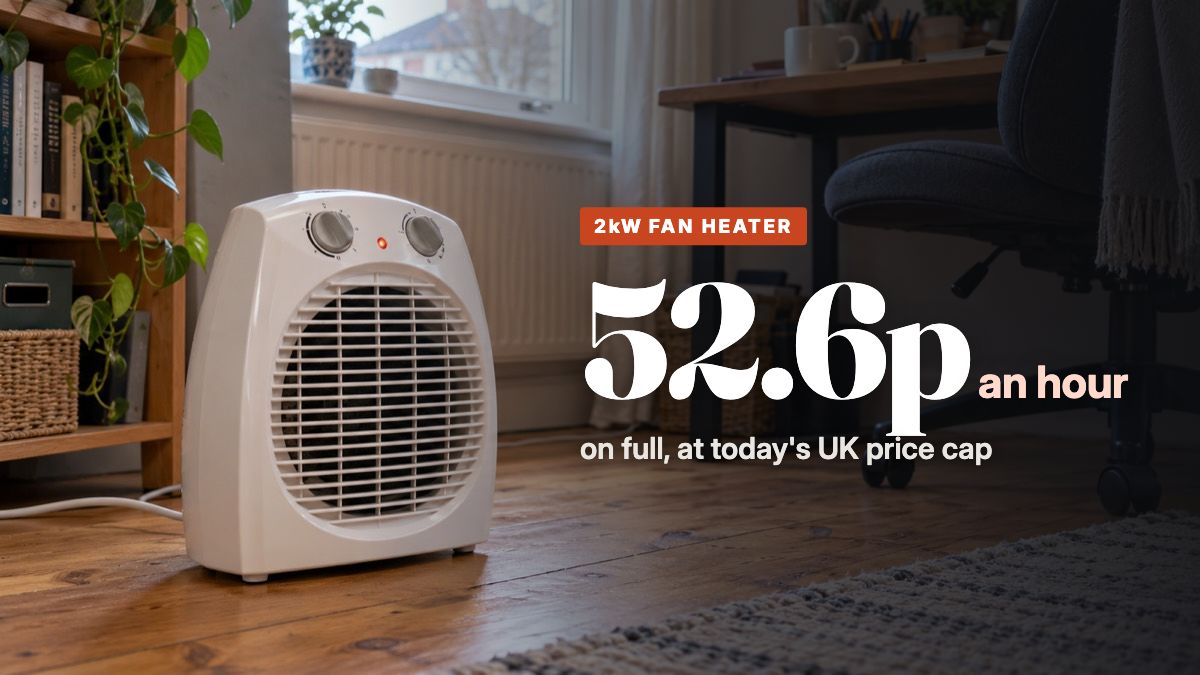
A 2kW fan heater draws 2 kilowatts on its full setting, which costs 52.6p an hour at the Ofgem cap rate of 26.32p per kWh, and the half setting on a model such as the Dimplex DXFF20TSN draws 1 kilowatt for 26.3p an hour. A 3kW model costs 79.0p an hour on full. Once the room is warm the thermostat switches the element on and off, so a three hour evening costs less than the £1.58 the plate rating suggests.
What a fan heater draws on each setting
A fan heater is a heating element with a small fan blowing air across it, and the element is what you pay for. The Dimplex DXFF20TSN, a basic flat fan heater sold widely in Britain, is rated at 2.0kW nominal output with a minimum of 1.0kW, and its control knob runs from off to cool blow, then half heat, then full heat. The 3kW version, the DXFF30TSN, steps between 1.5kW and 3.0kW in the same way.
Those numbers are the whole story on cost. On half heat a 2kW heater draws 1,000 watts, on full it draws 2,000 watts, and on cool blow the element is off and only the motor runs. Dimplex's own data table lists standby consumption at 0.0kW, so a heater left plugged in at the wall costs nothing until the thermostat calls for heat.
Dimplex does not print a wattage for cool blow. The nearest published figure from a maker is Dyson's specification for the Pure Hot+Cool, which puts fan mode at 40 watts at most, so treat 40 watts as the top end for cool blow on any fan heater.
Work it out for your own fan heater
Type in the wattage from the plate on the back, then your own unit rate. The numbers update as you type.
The cost per hour, per evening and per month
Two kilowatts for an hour is 2 kilowatt hours, and at the cap rate of 26.32p a unit that comes to 52.6p. The other settings follow the same arithmetic, so a reader with any fan heater can read the price off the plate.
| Setting | Power | Per hour | Three hour evening | Thirty evenings |
|---|---|---|---|---|
| Cool blow, motor only | 40 W | 1.1p | 3.2p | £0.95 |
| Half heat on a 2kW heater | 1,000 W | 26.3p | 79p | £23.69 |
| Half heat on a 3kW heater | 1,500 W | 39.5p | £1.18 | £35.53 |
| Full heat on a 2kW heater | 2,000 W | 52.6p | £1.58 | £47.38 |
| Full heat on a 3kW heater | 3,000 W | 79.0p | £2.37 | £71.06 |
The last two columns assume the element never switches off, which only happens in a cold, draughty room or with the thermostat turned up to maximum. They are the ceiling on what an evening can cost, and the real figure sits below it.
| Appliance | Typical draw | Usage we assume | Per hour (UK) | Per usage (UK) | Per month (UK) | Per hour (US) |
|---|---|---|---|---|---|---|
| Fan heater | 2000 W | per hour on full output | 52.6p | 52.6p | £47.90 | 36.7 cents |
Rates: Ofgem cap 1 October to 31 December 2026 at 26.32p per kWh (source), EIA residential average June 2026 at 18.34 cents per kWh (source). Checked 2026-09-22.
The thermostat decides the bill
The dial on top of most fan heaters is a thermostat, and it switches the element off once the air around the heater reaches the temperature you set. In a small room with the door shut a 2kW heater gets there quickly and then spends much of the evening idling, so if it ends up heating for half the time a three hour evening costs £0.79 rather than £1.58. In a large or draughty room the warm air leaks away as fast as the heater makes it and the element barely rests.
Fan heaters are more sensitive to this than other heaters because they store no heat. An oil filled radiator keeps radiating after its element cuts out, while a fan heater's air goes cold the moment the element stops, which is why the room temperature swings and the element clicks back on sooner. If you want to know your own duty cycle, note the kilowatt hours on your smart meter's in home display before and after an evening when nothing else heavy is running, and that one number tells you more than any table.
The frost setting on the Dimplex models holds a room at about 5°C, and Dimplex describes it as protection against frosty conditions. It is a sensible setting for a garage or a workshop with pipes in it, and on a mild night it may barely run at all.
Ceramic, coil or bladeless, the price is the same
Fan heaters are sold on features that sound like efficiency, ceramic plates, turbo modes, bladeless jets, but none of them changes the amount of heat you get from a kilowatt hour. Every resistive heater turns all of its electricity into heat in the room, so a 2kW ceramic model, a 2kW coil model and a 2kW designer fan heater all cost 52.6p an hour on full.
What does change is how the heat reaches you and how loud the machine is. A fan heater throws warm air across the room within seconds, which makes it the quickest heater to feel, and that makes it good for short stays and bad for long ones. The oil filled radiator guide covers the opposite case, a heater that is slow to warm up and slow to cool down, at exactly the same price per hour.
Against firing up the central heating
A gas boiler makes heat at about 8.9p a kilowatt hour once you allow for efficiency, at the current gas cap rate of 7.97p, while a fan heater makes it at 26.32p. The boiler is roughly 3 times cheaper for every unit of warmth, so the fan heater can only win by heating far less of the house.
That is often exactly what you want. An hour of the boiler running at around 10 kilowatts costs about 80p in gas, and it warms every radiator in the house, while one hour of a 2kW fan heater costs 52.6p and warms the one room you are sitting in. For a single home office on a weekday afternoon the fan heater is the cheaper tool, and for a family spread across three rooms in the evening the boiler is.
Using one without paying more than you need
- Shut the door of the room you are heating, because a fan heater blowing warm air into a hallway is heating the stairs.
- Start on full for the first ten minutes, then drop to half heat once the room feels warm, since half heat costs 26.3p an hour against 52.6p.
- Turn the thermostat down until the heater clicks off, then back up a notch, so it holds the room rather than overshooting it.
- Point it at the part of the room where you sit, as warm air rises and a heater aimed at an empty corner warms the ceiling first.
- Switch it off when you leave the room, because a fan heater has no stored heat and nothing is gained by keeping it running.
- Keep it plugged straight into a wall socket. Dimplex warns against extension leads and plug in timers for its fan heaters because heaters draw a high current and any weakness in the adaptor can overheat.
What it costs in the United States
At the EIA residential average of 18.34 cents per kilowatt hour, a 2,000 watt fan heater costs 36.7 cents an hour on full. Dyson's US Pure Hot+Cool is rated at 1,500 watts in heater mode, which comes to 27.5 cents an hour at the national average and 52.1 cents an hour in California.
Common questions
Does a fan heater use a lot of electricity?
Yes, for the time it is on. A 2kW fan heater on full uses 2 kilowatt hours every hour, as much as boiling a kettle for forty minutes, and it costs 52.6p an hour at the current cap. It only becomes cheap when you use it in short bursts in one closed room.
How much does it cost to run a fan heater on cold?
Very little, because only the motor is running. Dimplex does not publish a cool blow figure for its fan heaters, but Dyson's published specification for its Pure Hot+Cool puts fan mode at 40 watts at most, which is 1.1p an hour. The heat setting on a 2kW model draws fifty times that.
Is it cheaper to run a fan heater than central heating?
Only when you want one room warm for a short time. Gas heat from a boiler costs about 8.9p a kilowatt hour against 26.32p for a fan heater, so per unit of warmth the boiler is roughly 3 times cheaper. The fan heater wins when the alternative is firing the boiler for a whole house to warm one small room for an hour.
Are ceramic fan heaters cheaper to run?
No. A 2kW ceramic fan heater and a 2kW coil fan heater both turn 2 kilowatts of electricity into 2 kilowatts of heat, so both cost 52.6p an hour on full. Where they differ is surface temperature, noise and purchase price, and none of those shows up on the bill.
Can you leave a fan heater on overnight?
Eight hours on full costs £4.21, and Dimplex's own instructions warn against running its fan heaters through a plug in timer or an extension lead, against covering them, and against using them near a bath or shower. If the bed is what needs to be warm, an electric blanket does that for a few pence a night, and an oil filled radiator on its thermostat is a quieter way to keep the room itself above cold.