What does electric underfloor heating cost per hour to run in the UK?
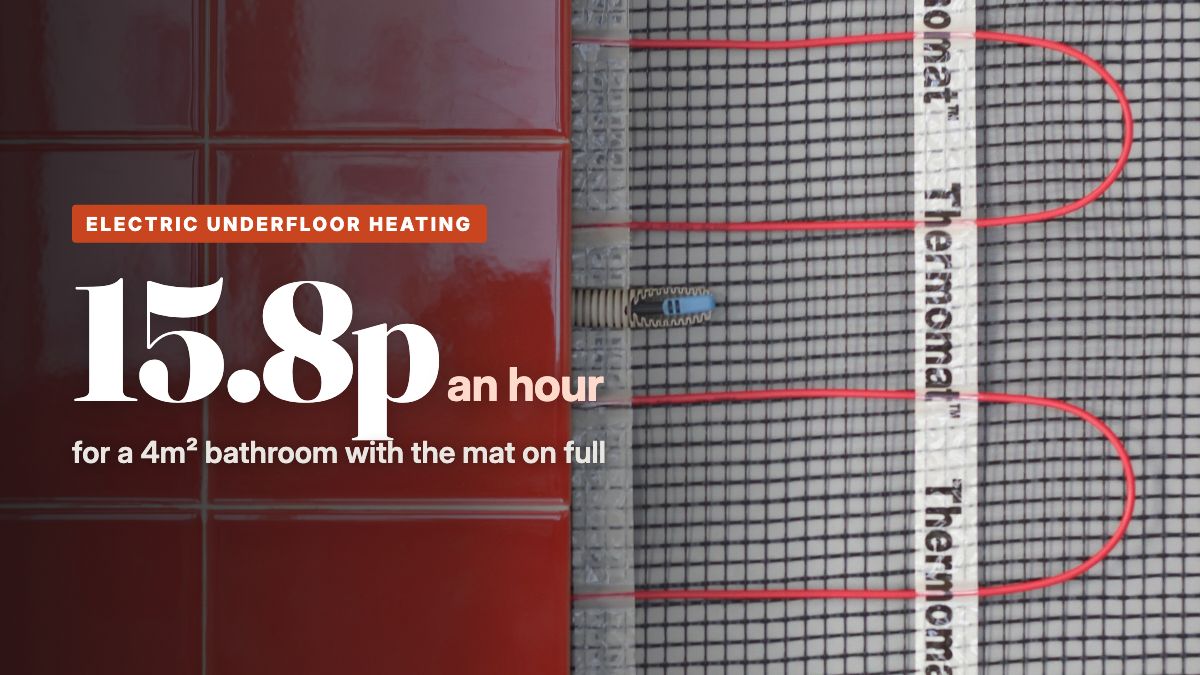
Electric underfloor heating is priced by the square metre. A mat rated at 150 watts per square metre, the Warmup StickyMat output for well insulated rooms, costs 3.9p per square metre for every hour at full output at the Ofgem cap rate of 26.32p per kWh, so a 4 square metre bathroom floor costs 15.8p an hour. Once the floor is up to temperature the thermostat cycles it, and Warmup's own published average works out at about 7.1p an hour for the same floor at today's rate.
What an electric mat draws, square metre by square metre
Electric underfloor heating is a thin heating cable laid in a mat under the tiles, and it is rated by the square metre rather than as a single appliance. Warmup's StickyMat, a mat made to be laid under tiles, comes in two outputs. The 150 watt per square metre mat is the one Warmup describes as able to provide primary heating in well insulated areas, and the 200 watt mat is meant for rooms with a high heat loss such as conservatories.
That makes the sum a multiplication. A 4 square metre heated area at 150 watts per square metre is a 600 watt heater spread across the floor, and the same area at 200 watts is 800 watts. The heated area is usually smaller than the room, because the mat does not go under the bath, the toilet or the kitchen units, so measure the open floor rather than the whole room before you work anything out.
Work it out for your own electric underfloor heating
Type in the wattage from the plate on the back, then your own unit rate. The numbers update as you type.
The cost per hour at full output, and once the floor is warm
At full output a 150 watt per square metre mat costs 3.9p per square metre each hour at the cap rate of 26.32p per kWh, and a 200 watt mat costs 5.3p. Full output is what the floor draws while it is warming up from cold, and also the most it can ever cost.
After that the thermostat takes over and switches the mat on and off to hold the floor temperature. Warmup publishes its own figure for this, an average of 0.7836p per square metre per hour after the initial heat up, worked with its 10mm insulation boards under the mat. The catch is that Warmup worked it at 11.61p per kilowatt hour, and today's cap rate is 2.3 times that. Turned back into energy that figure is 0.0675 kilowatt hours per square metre per hour, the 150 watt mat running for about 45 per cent of the time, and at 26.32p a unit it is 1.78p per square metre an hour.
| Floor | Heated area | Full output | Per hour at full output | Per hour once warm |
|---|---|---|---|---|
| Ensuite at 150 W/m² | 2.5 m² | 375 W | 9.9p | 4.4p |
| Bathroom at 150 W/m² | 4 m² | 600 W | 15.8p | 7.1p |
| Bathroom at 200 W/m² | 4 m² | 800 W | 21.1p | no published figure |
| Kitchen at 150 W/m² | 10 m² | 1,500 W | 39.5p | 17.8p |
| Conservatory at 200 W/m² | 12 m² | 2,400 W | 63.2p | no published figure |
The last column only applies where Warmup's own conditions hold, a 150 watt mat on insulation boards in a reasonably insulated room. A mat laid straight onto a cold concrete slab loses part of its heat downwards into the ground, and Warmup itself says insulation boards can cut the running cost by as much as half, so an uninsulated floor will sit nearer the full output column.
| Appliance | Typical draw | Usage we assume | Per hour (UK) | Per usage (UK) | Per month (UK) | Per hour (US) |
|---|---|---|---|---|---|---|
| Electric underfloor heating | 600 W | per hour, 4 m² floor at full output | 15.8p | 15.8p | £19.16 | 11.0 cents |
Rates: Ofgem cap 1 October to 31 December 2026 at 26.32p per kWh (source), EIA residential average June 2026 at 18.34 cents per kWh (source). Checked 2026-09-22.
Per day, per month and across a winter
A sensible programme for a bathroom floor runs twice a day, before the morning showers and again in the evening. For a 4 square metre bathroom on four hours a day, the floor costs 63.2p a day if the mat ran flat out the whole time and about 28.4p a day on Warmup's average. Over a month of thirty days that is between £8.53 and £18.95.
Warmup's own figure assumes a six month heating season of 182 days. Across that season the same bathroom floor costs about £51.73 on the average and up to £114.97 at full output, which is a fair range to keep in mind when a fitter quotes a running cost from an old unit rate.
A larger floor scales in proportion. A 10 square metre kitchen floor on the same four hours a day costs about £21.32 a month on Warmup's average, and that is the point at which underfloor heating starts to show up as a line on the bill rather than a rounding error.
Leaving it on, or using the programme
A warm floor holds heat for a while, which tempts people to leave it on all day so it never has to warm up from cold. The arithmetic does not favour that. On Warmup's own average a 4 square metre bathroom held warm for twenty four hours uses about 6.5 kilowatt hours, £1.71 a day, against about 28p for four hours a day, and the heat that keeps an empty bathroom floor warm at 3am is heat nobody uses.
The better approach is the one the thermostat was built for. Set the programme to start the floor about an hour before the first shower, let it run through the busy part of the morning and switch it off, then repeat in the evening. If the floor takes too long to feel warm from cold, that is usually a sign of heat escaping downwards, and the fix is insulation under the mat at the next refit rather than a longer timer.
Against electric radiators, gas radiators and wet underfloor heating
Electric underfloor heating costs exactly the same per unit of heat as an oil filled radiator or a fan heater, 26.32p per kilowatt hour, because all of them turn electricity straight into heat. What differs is how the heat arrives. The floor warms the room from below at a low surface temperature over a large area, which is pleasant underfoot and makes a bathroom dry out quickly after a shower.
Gas is a different price. A gas boiler makes heat at roughly 8.9p a kilowatt hour once you allow for efficiency, so a radiator or a wet underfloor system fed by the boiler is about 3 times cheaper to run than an electric mat delivering the same heat. Electric mats are cheap and quick to fit under a bathroom floor, which is why they suit one small room, and wet systems cost more to install and less to run, which is why they suit a whole ground floor.
Keeping the running cost down
- Fit insulation boards under the mat if the floor is coming up anyway, since Warmup says they can cut the running cost by as much as half.
- Choose the 150 watt per square metre mat for a well insulated bathroom or kitchen, and keep the 200 watt mat for genuine high heat loss rooms such as conservatories.
- Programme the thermostat around the times the room is used, and turn the floor temperature down a degree or two once it feels comfortable.
- Leave rugs and bath mats off a heated floor where you can, because they insulate the tiles from the room and the mat runs longer to push heat through them.
- Keep the bathroom door shut while the floor warms up, so the heat stays in the room you are paying to warm.
What it costs in the United States
At the EIA residential average of 18.34 cents per kilowatt hour, a 4 square metre heated floor at 150 watts per square metre, about 43 square feet, costs 11.0 cents an hour at full output and about 5.0 cents an hour on Warmup's average once it is warm. Four hours a day for a month on that average comes to about $5.94.
Common questions
Is electric underfloor heating expensive to run?
Per hour it is modest in a small room and expensive in a large one, because the cost scales with the heated area. A 4 square metre bathroom at 150 watts per square metre costs 15.8p an hour at full output, while a 12 square metre conservatory at 200 watts per square metre costs 63.2p an hour, more than a 2kW fan heater.
How many kWh does electric underfloor heating use?
At full output a 150 watt mat uses 0.15 kilowatt hours per square metre every hour and a 200 watt mat uses 0.2. Warmup's published running cost implies an average of about 0.0675 kilowatt hours per square metre per hour once the floor is warm and insulated, so a 4 square metre bathroom uses roughly 0.27 kilowatt hours an hour.
Can you leave electric underfloor heating on all the time?
You can, but it costs far more than a timer. Using Warmup's own average, a 4 square metre bathroom held warm around the clock uses about 6.5 kilowatt hours a day, £1.71 at the current cap, against about 28p for four hours a day on the thermostat's programme.
Is electric underfloor heating cheaper than radiators?
Not than electric radiators, because both turn a kilowatt hour into a kilowatt hour of heat and both cost 26.32p a unit. Against radiators on a gas boiler it is roughly 3 times dearer per unit of heat, since boiler heat costs about 8.9p a kilowatt hour.