How much does a pond pump cost to run per month in the UK?
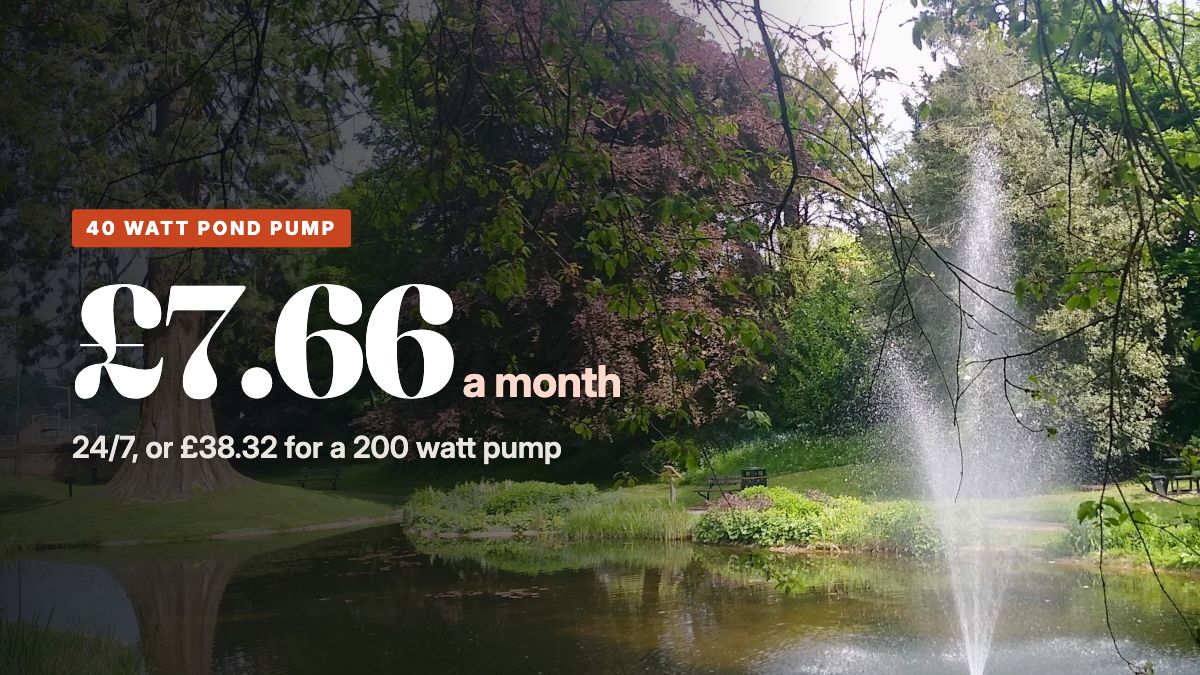
Hozelock rates its Cascade 4000 pond pump at 40 watts, so running it around the clock uses 0.96 kilowatt hours a day and about 29 kilowatt hours a month, which costs £7.66 a month at the Ofgem cap rate of 26.32p per kWh and £92.23 over a year. The 6 watt Cascade 450 sold for small ornaments costs £1.15 a month, and a 185 watt Titan 8000 feeding a large filter costs £35.45.
What a pond pump draws
Pond pumps run on far less power than most people fear, and far more hours than most other things in the house. That combination is the whole story of the bill.
Hozelock publishes the rating of every pump in its Cascade and Titan ranges on one datasheet. The Cascade 450, sold for small ornaments, is rated at 6 watts. The Cascade 1000, which Hozelock says will give a good small waterfall, is 18 watts, and the Cascade 4000 pushes 4,000 litres an hour on 40 watts. Above that the numbers jump, with the Cascade 5500 at 115 watts and the 7000 at 175. The Titan pumps, which handle solids and which Hozelock recommends for feeding a filter, run from 25 watts for the Titan 2000 to 185 watts for the 5500 and 8000 and 200 watts for the 12000.
We use the 40 watt Cascade 4000 as the everyday figure, and assume it runs 24 hours a day.
Work it out for your own garden pond pump, 4,000 litres an hour
Type in the wattage from the plate on the back, then your own unit rate. The numbers update as you type.
What each pump costs a day, a month and a year
| Pump | Power | Per hour | Per day | Per month | Per year |
|---|---|---|---|---|---|
| Cascade 450, ornament | 6 W | 0.16p | 3.8p | £1.15 | £13.83 |
| Cascade 1000, small waterfall | 18 W | 0.47p | 11.4p | £3.45 | £41.50 |
| Cascade 2000 | 24 W | 0.63p | 15.2p | £4.60 | £55.34 |
| Cascade 4000 | 40 W | 1.1p | 25.3p | £7.66 | £92.23 |
| Titan 3000, filter feed | 40 W | 1.1p | 25.3p | £7.66 | £92.23 |
| Cascade 5500 | 115 W | 3.0p | 73p | £22.04 | £265.15 |
| Cascade 7000 | 175 W | 4.6p | £1.11 | £33.53 | £403.49 |
| Titan 8000, filter feed | 185 W | 4.9p | £1.17 | £35.45 | £426.54 |
| Titan 12000, filter feed | 200 W | 5.3p | £1.26 | £38.32 | £461.13 |
A month here is four and a third weeks, a twelfth of the year. At 40 watts the pump uses about 350 kilowatt hours a year, which is half as much again as a typical chest freezer, and the large pumps use more than a whole fridge freezer and a chest freezer put together.
| Appliance | Typical draw | Usage we assume | Per hour (UK) | Per usage (UK) | Per month (UK) | Per hour (US) |
|---|---|---|---|---|---|---|
| Garden pond pump, 4,000 litres an hour | 40 W | per 24 hours running | 1.1p | 25.3p | £7.66 | 0.73 cents |
Rates: Ofgem cap 1 October to 31 December 2026 at 26.32p per kWh (source), EIA residential average June 2026 at 18.34 cents per kWh (source). Checked 2026-09-22.
Flow per watt, and why the height of the waterfall matters
The datasheet also holds the figure that decides which pump is cheapest for your pond. At pond level the Cascade 4000 moves 100 litres an hour for every watt, the 5500 moves 48 and the 7000 moves 40, so on paper the smaller pump looks more than twice as efficient.
That changes once the water has to climb. Hozelock lists the flow at different heads, meaning the height the water is lifted above the pond surface. At 2 metres the Cascade 4000 manages only 500 litres an hour, while the 5500 still delivers 3,250. Lifted that high, the bigger pump moves about 28 litres an hour per watt against 12.5 for the smaller one, so it does more than twice the work for each penny.
The practical rule is to buy for the height of your waterfall or filter outlet as well as the size of the pond. A pump that is too small for the head runs all day for a trickle, and a pump far bigger than a low fountain needs costs more every hour for flow you end up turning down on the controller.
Pump, filter and UV
Most people searching for the cost of a pump and filter can relax a little, because the filter box itself has no motor and uses no power. The pump pushes water through it and back to the pond, and its rating is the electricity cost of the whole arrangement.
A UV clarifier changes that. The lamp inside draws its own wattage for every hour it is on, and that figure is printed on the unit and in its manual. Add it to the pump in the calculator above to get the true running cost.
Low voltage pumps
Hozelock's low voltage Cascades come in the same sizes and the same watt ratings as the mains versions, with a transformer that stays away from the pond and a 3 metre cable that can be extended to 50 metres. The pump costs the same to run, but the transformer has small losses of its own that Hozelock does not publish, so treat the figures above as a slight underestimate for a low voltage setup.
Where the real savings are
- Match the pump to the head height. Going up a size for a tall waterfall can cost less per litre than forcing a small pump to strain.
- Put a fountain or waterfall that is only there for looks on a timer. Running a 40 watt pump eight hours a day instead of 24 saves £5.11 a month.
- Clean the pump strainer on the schedule in the manual, because a clogged strainer cuts the flow you are paying for.
- Compare the watt rating on an old pump's label with a current model of the same flow before deciding whether to keep it, because the running cost follows the watts.
- If the pump feeds a filter on a fish pond, follow the filter maker's guidance on running hours before cutting them.
What this costs in the United States
At the EIA residential average of 18.34 cents per kilowatt hour, a 40 watt pump running around the clock costs $5.34 a month and $64.26 a year. In California at 34.74 cents the year comes to $121.73, and in Texas at 15.94 cents it comes to $55.85. A 200 watt pump costs five times those figures.
Common questions
Do pond pumps use a lot of electricity?
Each hour costs very little, but the pump runs every hour of the day, and that is what makes it add up. A 40 watt pump uses about 350 kilowatt hours a year, which is half as much again as a typical chest freezer and costs £92.23 at the cap rate. A small 6 watt ornament pump costs £13.83 a year, and a 200 watt pump for a large koi pond costs £461.13.
How much does it cost to run a pond pump 24/7?
Multiply the watts by 24 to get watt hours a day, divide by 1,000, then multiply by your unit rate. A 40 watt pump uses 0.96 kilowatt hours a day, which is 25p a day, £7.66 a month and £92.23 a year. A 115 watt pump costs £22.04 a month on the same basis.
How much does it cost to run a pond pump and filter?
The pump is usually the only thing using electricity, because a box or pressure filter has no motor of its own and relies on the pump to push water through it. The exception is a filter with a UV clarifier built in, which adds the wattage of its lamp, printed on the unit, for every hour it is switched on. Add that figure to the pump's watts in the calculator above.
How many watts does a pond pump use?
Anything from 6 to 200 watts for a garden pond. Hozelock's Cascade range runs from 6 watts for the 450 to 175 watts for the 7000, and its Titan solids handling pumps, which Hozelock recommends for filtration, run from 25 watts for the Titan 2000 to 200 watts for the Titan 12000.
Should I turn my pond pump off at night?
If the pump only runs a fountain or a waterfall for looks, a timer is the easiest saving there is, and running a 40 watt pump eight hours a day instead of 24 saves £5.11 a month. If it feeds a filter on a pond with fish, check the filter maker's instructions before you put it on a timer, because the filter is built around water passing through it.